
Free aged care placement services vs independent advice
- Louise Greene and Kerry Mann

If a service is free to you or your family, someone else is paying for it.
Table of Contents
ToggleWe see this regularly. A family is offered free help finding an aged care home or a Support at Home provider, and nobody has explained how that service is being paid. Usually it is paid by the provider it recommends, once the older person signs on to the service.
An independent aged care adviser is paid by you or your family instead, and receives no financial benefit from the provider selected.
Both models are legitimate. They are not the same, and the difference matters when the advice impacts the choice and what it costs.
Free to you or your family is not free. Provider-funded placement services are paid a referral fee when your person signs on.
The amounts are significant. Several thousand dollars for a residential placement, and for Support at Home the fee may be 5 to 10 per cent of the annual package value.
A referral fee does not make the advice bad. It does mean you should ask what happens when the most suitable provider is not in their network.
It is worth getting the decision right the first time. Changing a Support at Home provider is straightforward. Moving someone from one aged care home to another is disruptive and hard to undo.
Some free help is genuinely free. My Aged Care and the care finder service are government funded and take no referral payments.
At Aged Care Conversations we are paid only by older people and their families. No commissions, no referral payments, no placement fees, no provider partnerships.
Written by Louise Greene RN and Kerry Mann, aged care specialists. Reviewed September 2026. Sources: My Aged Care and the Department of Health, Disability and Ageing.
The difference · What referral fees are worth · Whether that makes a service unsuitable · What an independent adviser does · Which free services are genuinely free · How to tell which is which · How we work
What is the difference between the two?
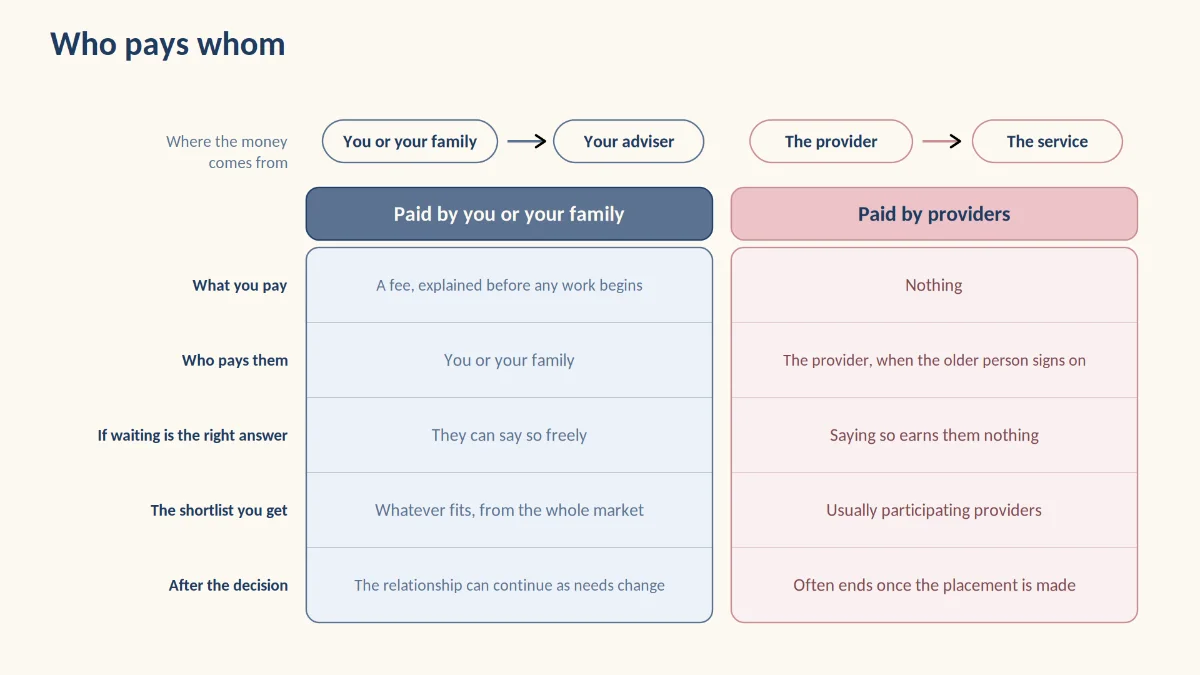
Some private aged care placement services have commercial arrangements with residential aged care homes or Support at Home providers. When an older person enters a participating home or chooses a participating provider, that provider pays the placement service a referral or introduction fee. The amounts are not small, and we set them out in the next section.
An independent adviser is paid directly by the older person or their family, and receives no commissions, placement fees or referral payments from the providers being considered.
| Paid by you or your family | Paid by providers | |
| What you pay | A fee, explained before any work begins | Nothing |
| Who pays them | You or your family | The provider, when the older person signs on |
| If waiting is the right answer | They can say so freely | Saying so earns them nothing |
| The shortlist you get | Whatever fits, from the whole market | Usually participating providers |
| After the decision | The relationship can continue as needs change | Often ends once the placement is made |
The difference is simple. A provider-funded service is paid by the provider receiving the referral. An independent adviser is paid by the person receiving the advice.
How much can a provider pay for a referral?
The amounts can be significant.
A referral fee for a residential aged care placement can be several thousand dollars.
For Support at Home, some referral fees are calculated as a percentage of the person’s annual funding allocation. We have seen arrangements ranging from 5 to 10 per cent of the annual package value.
You or your family may not pay this directly. It is worth understanding the commercial relationship sitting behind the recommendation, because on a higher Support at Home classification that percentage is not a small sum.
The question is not simply whether the service is free. The question is whether it is carefully evaluating your person’s needs, circumstances and preferences across all suitable options, or only across providers it has an arrangement with.
Does a referral fee mean the service is unsuitable?
No, and it would be unfair to suggest otherwise.
Provider-funded placement services offer practical help at a stressful time. They identify vacancies, contact providers and arrange introductions without charging you or your family directly. For some situations that is exactly what is needed.
But it is worth understanding the limits of the service. If a placement business is paid only by participating providers, ask what happens when the most suitable provider is not part of its network. Will that provider still be included? Will you be told that other options exist?
The payment arrangement does not automatically make the advice poor. It does mean the relationship should be clear before you rely on it.
The stakes are not the same for both decisions. Changing a Support at Home provider is not especially difficult. If the fit is wrong you can move, and your referral code goes with you.
Moving an older person from one aged care home to another is a different matter. It means leaving a room they have settled into, staff they have come to know, and a routine that took months to build. It is disruptive at any age and considerably harder for someone living with dementia. There is also the accommodation payment to unwind and negotiate again.
Whichever kind of care you are looking at, it is worth taking the time to get the decision right the first time.
What does an independent aged care adviser do?
An independent adviser works for you and your family, and where able, the older person leads the decision.
Because you pay for the advice, the adviser does not need a commercial agreement with a provider before including that provider in the search. That allows a broader search, built around your person’s needs, preferences and the kind of care environment that will actually suit them.
Depending on what you and your family need, an independent adviser may:
- make sure you have the right information
- help you understand your person’s care needs and the options available
- consider the environment and care model best suited to your person’s needs
- take account of future health needs, not just today’s
- identify suitable residential aged care homes or Support at Home providers
- find suitable vacancies
- explain and compare services, care and costs
- streamline applications and paperwork
- prepare you for meetings and tours
- explain agreements before they are signed
- support you and your family through the transition
- help you plan for changing care needs
The role is to listen to your situation, explain the options, and talk them through in a practical and straightforward way.
Are all free aged care services paid by providers?
No. Some free services are funded by the Australian Government and rely on no referral payments at all.
My Aged Care, 1800 200 422. Information about government-funded services, and the assessment that opens access to them.
The Care Finder service. Free, intensive support for eligible vulnerable older people who do not have someone they trust to help them access aged care. There are care finder organisations across Australia and you call the one in your region.
Services Australia, 1800 227 475. Aged Care Specialist Officers have expert knowledge of the aged care system and can sit down with you in person at many service centres. They can explain how the system works, what you may be entitled to, fees and means testing, and how your circumstances affect what you will pay.
Carer Gateway, 1800 422 737. Counselling, respite and practical support for carers in their own right.
Dementia Support Australia, 1800 699 799. Free, 24 hours, for behaviour changes nobody can make sense of.
Older Persons Advocacy Network, 1800 700 600. Free, independent advocacy about aged care rights and about problems with a provider.
These are different from a private placement business that receives a fee from a provider when someone signs up. Use them first. Paid advice earns its place when the situation is complex, when timing is tight, or when nobody has the capacity to run the process.
How can you tell which one you are dealing with?
Not by the words on the website. Provider-funded services describe themselves as free and independent, and family-paid advisers describe themselves as independent too. Both use the same language, so neither term tells you anything about who is paying.
Ask instead:
- Who pays you?
- Do you receive a commission, referral payment or placement fee?
- How is that payment calculated?
- Do providers have to join your network before you can recommend them?
- Do you recommend all suitable providers, or only participating providers?
- If the best option does not pay you, will you still recommend it?
- Can you explain your payment arrangements in writing?
The answers will tell you whose interests the service is being paid to represent.
Question six is the one worth listening to most carefully. It is the point where the two models genuinely diverge, and nobody has a prepared answer for it.
Why Aged Care Conversations works differently
Aged Care Conversations is paid directly by you or your family.
We do not accept commissions, referral payments or placement fees from residential aged care homes, retirement villages or Support at Home providers. We have no provider partnerships and no panel. The search is open, and we start from your person’s own criteria, considering care needs, location, budget and a range of other factors.
We work only for older people and their families.
Where able, the older person leads. It is their life, their home and their money, and being supported to make a decision is not the same as having it made for you.
We keep our fees deliberately low, because we want older people and families to have access to experienced, independent guidance without facing another large expense. Before any paid work begins we explain our fees and the likely cost of our assistance, and we keep you informed as the work progresses, so you know what has been done, what comes next, and whether any additional cost may be involved.
Louise and Kerry have both spent years in aged care and bring a broad range of expertise to it. Louise is a registered nurse with extensive aged care experience. Kerry brings deep experience across the sector, including how providers, funding and policy work in practice. Between us we can look at a situation clinically and practically at the same time, which is exactly what most older people and families are trying to do on their own.
Frequently asked questions
Is aged care advice free?
Some of it is. My Aged Care, the care finder service, Services Australia, Carer Gateway and Dementia Support Australia are free and have no commercial interest. Private placement services are also free to you, but they are paid by providers. Independent advisers charge a fee and take no provider payments.
How do free placement services make money?
The provider pays them when your person signs on. It is a legitimate model and it is disclosed if you ask, but the service earns only when a placement happens, and usually only with providers it has an arrangement with.
How much is a referral fee?
For a residential placement it can be several thousand dollars. For Support at Home, some are calculated as a percentage of the annual funding allocation, and we have seen arrangements between 5 and 10 per cent of the annual package value.
What is a provider panel?
A list of providers a service works with, often under a fee arrangement. Ask how many are on it and how they were chosen, because a panel is a shortlist of businesses rather than a shortlist of homes that suit your person.
Can you recommend a specific aged care home?
We look for the homes that best meet your person’s needs rather than any arrangement with a provider, because we have none. We always suggest a shortlist, because availability varies.
The bottom line
Ask who pays. It is one question, it is not rude, and any service operating properly answers it in a sentence.
Independent advisers are paid by older people and their families, and can recommend anything, including waiting. Placement services are free to you and are paid by providers when a placement happens. Both models exist openly, and the difference matters most at the moment people are least equipped to notice it, usually the week after a hospital admission.
Before you pay anyone, use what is already free. My Aged Care on 1800 200 422 will answer more than most people expect.
We always start with a complimentary call, to hear what is happening and see whether we can help. Sometimes the issue is straightforward and we can simply point you in the right direction. If more help is needed, we will explain what we can do and what it is likely to cost, before any work begins.
Arrange a complimentary call
Aged Care Conversations provides independent, commission-free aged care guidance and cost modelling. It does not provide financial, taxation, legal or medical advice.
Program rules and funding arrangements are set by government and change over time. Always confirm current details for your situation with My Aged Care on 1800 200 422.
Sources: My Aged Care and the Department of Health, Disability and Ageing.
Get the assessment guide
General information only. This article explains how the aged care assessment process works and is not financial, legal or medical advice. Program rules and funding arrangements are set by government and change over time. Always confirm current details for your situation with My Aged Care on 1800 200 422 or at myagedcare.gov.au.
Sources: My Aged Care and the Department of Health, Disability and Ageing.
For More Information
Call us, or book a free 15-minute conversation. If we’re not the right help for you, we’ll say so – and point you somewhere that is.