
The Aged Care Assessment Explained
- Louise Greene and Kerry Mann

What are the four charges? The Aged Care Assessment Explained: What Happens, How to Prepare and What Replaced ACAT
ACAT no longer exists under that name. Aged care assessments are now done by the Single Assessment Service, using a questionnaire and algorithm called the Integrated Assessment Tool, and the algorithm, not the assessor, decides the funding classification.
Table of Contents
ToggleThat last point changes how the older person and the family should prepare.
- ACAT and the Regional Assessment Service have been combined into the Single Assessment Service. Many assessors are the same experienced people, working under a new system.
- Every assessment uses the Integrated Assessment Tool (IAT). For Support at Home (which replaced the Home Care Packages Program), the algorithm sets the classification and, since 1 November 2025, the assessor cannot change it.
- The algorithm leans heavily on the functional answers: what the person can and cannot do for themselves. Small differences there can move the funding by tens of thousands of dollars a year.
- Answer for the worst days, not the good ones. The funding follows what is recorded.
- The assessment is free, and the older person can have someone with them.
Written by Louise Greene RN and Kerry Mann, aged care specialists. Reviewed October 2026. Sources: My Aged Care, the Department of Health, Disability and Ageing, evidence to the Senate Inquiry into Support at Home, and the ABC’s Four Corners.
What replaced ACAT · Who needs an assessment · How to apply · On the day · How the algorithm decides · How the process works now · Why one point matters · What is changing · How to prepare · After the assessment
What replaced ACAT?
The Single Assessment Service replaced the Aged Care Assessment Team (ACAT) and the Regional Assessment Service (RAS). Before the change there were two assessment workforces: RAS for lower level home support, and ACAT for home care packages, residential care and more complex needs. Now one service does all of it.
Families still say ACAT, and so do many doctors and hospital staff. When someone mentions an ACAT assessment, they mean the aged care assessment. It is the same front door, arranged through My Aged Care.
The bigger change is the tool. Every assessment now uses the Integrated Assessment Tool, and for Support at Home (which replaced the Home Care Packages Program) the tool’s algorithm produces the funding classification.
Who needs an aged care assessment?
Anyone who wants government funded aged care. That includes the Commonwealth Home Support Programme (CHSP), Support at Home, respite care, residential aged care and the Transition Care Programme.
Eligibility generally starts at 65, or 50 for Aboriginal and Torres Strait Islander people and for people who are homeless or at risk of homelessness. The assessment itself costs nothing.
How do you apply?
A My Aged Care assessment is arranged in one of three ways: online, which takes about twenty minutes in three parts; by phone on 1800 200 422; or through a referral from a GP or hospital.
Each referral is given a priority: Urgent, High, Medium or Low. As a guide, it is commonly two to six weeks from application to assessment, then another two to six weeks for the written outcome. Waits vary, and they have been long. As at 31 March 2026, there were 98,606 referrals still waiting for an assessment.
The older person should know the application is being made and, where they are able, agree to it. This is their assessment and their care.
What happens on the day?
An assessor from the Single Assessment Service works through a structured set of questions with the older person about how they manage day to day: showering, dressing, meals, medications, getting around the house and leaving the house. They ask what help is needed and what help is already in place. It usually takes about an hour.
Most assessments happen at home. They can also be done by phone, or at the bedside if someone is in hospital.
We cover the day itself in more detail in what happens at an aged care assessment.
How does the algorithm decide your funding?
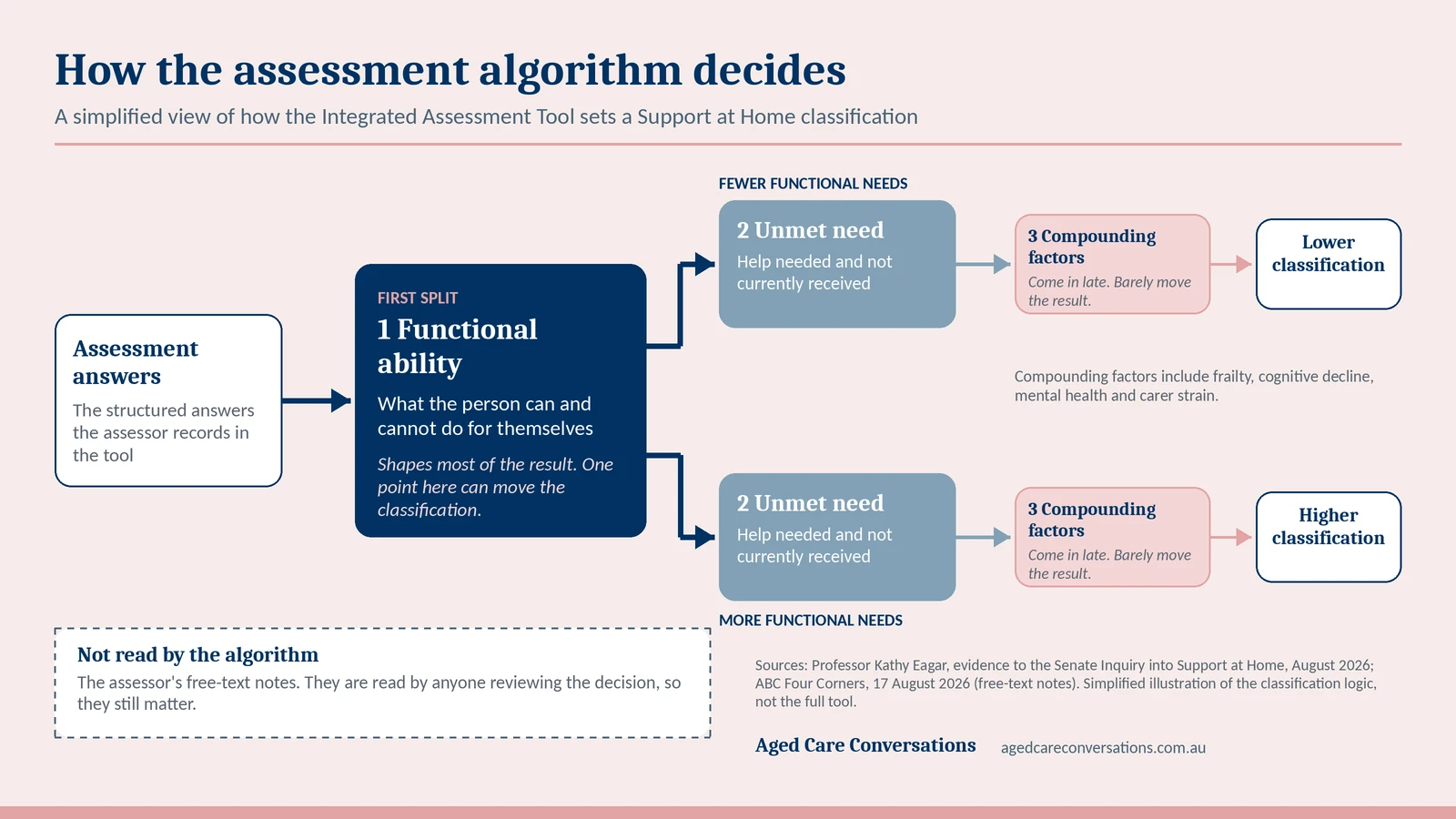
For Support at Home, the answers go into an algorithm, and the algorithm sets the classification. The assessor records the answers, and the tool makes the decision.
Professor Kathy Eagar, who led the design of the AN-ACC funding model used in aged care homes, explained how the algorithm works in evidence to the Senate Inquiry into Support at Home in August 2026.
The tool scores the person in three areas:
- Functional ability. What the person can and cannot do for themselves.
- Unmet need. What help is needed and not currently being received.
- Compounding factors. Things like frailty, cognitive decline, mental health and carer strain.
The algorithm works like a decision tree. The first branch is the functional score, and that first split shapes most of the result. The compounding factors come in so late that they barely move the outcome.
So dementia, depression and an exhausted carer are recorded, and they matter to the person’s care. They are not doing much of the work in deciding the funding. The functional answers are.
The tool asks 622 questions, and roughly 80 per cent of them are not used by the algorithm at all.
Do the assessor’s notes count?
The assessor’s notes are not included in the algorithm. The tool has more than 100 free text fields for notes, and the ABC’s Four Corners reported on 17 August 2026 that the algorithm does not read them. The classification comes from the structured answers, and mostly the functional ones.
Families are usually shocked when they hear this. They assumed everything they told the assessor counted, and the notes are where the real story usually goes. You tell the assessor about the night your mother could not find the bathroom. The assessor writes it down. The algorithm that produced the number did not read it.
The notes still matter. The assessor can check and correct the structured answers before the outcome is finalised, so what they hear from you can change what the algorithm is given. And anyone reviewing the decision later reads the notes, which makes them the evidence for a review or an escalation. The story has to land in the structured answers, and it needs to be in the notes as well.
How does the process work now?
- The assessor completes the assessment in the Integrated Assessment Tool, recording the person’s clinical, functional and social circumstances.
- The algorithm applies the Aged Care Rules and produces the classification and the priority.
- The assessor can correct information that was entered wrongly, but cannot replace the classification with their own clinical judgement.
- The older person receives the outcome. If it does not reflect their needs, they can ask for the decision to be reviewed through the Department’s reconsideration process.
Why can one point change the funding?
Because the first split carries so much weight, a single point in the functional score can move someone between classifications.
Professor Eagar gave the inquiry an example of two people with otherwise identical needs, one point apart, landing at Classification 5 and Classification 8.
Classification | Annual budget |
Classification 5 | $40,729.53 |
Classification 8 | $80,137.12 |
That is a difference of almost $40,000 a year, for two people an assessor might describe in nearly the same words. These are the published amounts from 1 July 2026. Budgets increase slightly from 1 October 2026 to fund higher award wages for aged care nurses.
With 133,359 assessments completed between 1 January and 31 March 2026 alone, small scoring differences affect a lot of people.
What is being done about it?
The tool is under more scrutiny now than at any point since it was introduced in 2024, and the position is moving. As at the date of this article:
The override was removed on 1 November 2025. Under the new Aged Care Act, assessors lost the ability to override a Support at Home classification produced by the algorithm.
An escalation process has been proposed. On 17 September 2026 the Government moved amendments to add a step for cases the tool does not capture well. Under the proposal:
- The assessment and the algorithm run as they do now.
- If the assessment organisation believes the classification does not reflect the person’s complex or exceptional circumstances, it can, with the older person’s consent, escalate the case to the Department.
- The System Governor, meaning the Secretary of the Department of Health, Disability and Ageing or a delegate, can then substitute a different outcome where set criteria are met.
This is not an override for every assessor. The criteria for which cases qualify are still to be written into the Aged Care Rules, the Government has said it will consult on them, and the amendments are not yet law. If it goes ahead, it is likely to matter most for people whose needs are hard to capture in structured questions: cognitive decline alongside changing behaviour, needs that fluctuate from day to day, an exhausted carer, or social isolation. It is also different from asking for a new assessment.
The assessor guidance has been updated. The Department published a revised Integrated Assessment Tool User Guide on 28 August 2026. It is the guidance assessors work from, and it shows the operational detail is still moving alongside the legislation.
The Senate has passed a separate bill to restore human override. It has not passed the House of Representatives.
A review of the prioritisation mechanism is under way. Classification decides how much funding someone receives. Prioritisation decides where they sit in the queue for it. The Government announced a three month review of prioritisation in June 2026, and it has run past its deadline. People with motor neurone disease now go automatically to the urgent pathway.
For anyone being assessed this month, the practical position is unchanged. The algorithm decides, and the assessor cannot override it. That is why preparation matters so much.
How do you prepare for the assessment?
Prepare so the functional questions are answered accurately, from evidence rather than an impression formed in an hour.
An assessor arrives mid-morning, when there is a visitor to rise to the occasion for. Nobody is being deceptive. But if the answers describe that one good hour rather than the whole week, the funding follows the hour. Phone assessments carry the same risk in a different form: it is easy to sound capable on the phone.
We often hear it on the day. Mum tells the assessor she showers every day, when her daughter knows it is twice a week, with help.
If showering goes badly two mornings in three, that is the answer, not the third morning. The assessment is meant to capture what life is actually like.
Not “she manages showering”, but what actually happens. How long it takes. Who is there. What happens when nobody is.
A diagnosis on its own does not tell the tool much. “Dementia”, “Parkinson’s” or “frailty” does not say how much help the person needs. The impact on daily life does.
A short daily note of falls, near misses, missed meals, missed medications and nights up. It turns “sometimes” into a number, and numbers are what the functional questions need.
A current medication list, recent GP or specialist letters, and any hospital discharge summaries. They support what you say and save time on the day.
The older person can have a family member, friend or registered supporter with them, in person or on the phone. The older person leads and answers for themselves where they can. The support person fills in what is being left out, kindly and accurately.
What happens after the assessment?
The outcome comes as a letter and a support plan. For Support at Home it includes:
- a summary of the person’s aged care needs and goals
- the classification and quarterly budget
- the approved services
- any short term supports, such as the Restorative Care Pathway, the End-of-Life Pathway or the Assistive Technology and Home Modifications scheme.
Approval is not the same as funding. For Support at Home there is then a wait for funding to be allocated before services can start.
If something was recorded wrongly, say so. Assessors can correct the information entered, even though they cannot change the classification the algorithm produces from it.
If the outcome does not reflect the person’s needs, you can ask for the decision to be reviewed through the Department’s reconsideration process. The outcome letter explains how and the timeframe, so read it as soon as it arrives. Reviews do change outcomes. The Guardian reported in August 2026 that of 757 requests for review up to 31 March 2026, 141 resulted in a higher classification or higher priority. That is close to one in five. If needs change later, for example after a fall or a hospital stay, you can ask for a new assessment.
For what happens next with the funding itself, see our guide to Support at Home. If an aged care home is on the horizon, the costs are explained in how much residential aged care costs.
Frequently asked questions
Is an ACAT assessment still done?
Not as a separate service. ACAT and the Regional Assessment Service have been combined into the Single Assessment Service. People still use the name ACAT, and it refers to the same aged care assessment.
Does an aged care assessment cost anything?
No. The assessment is free. Costs only arise later, depending on the services used and the person’s income and assets.
How long does it take to get an aged care assessment?
As a guide, two to six weeks from application to assessment and another two to six weeks for the written outcome. Urgent referrals are seen sooner. Waits vary by region and have been long in 2026.
Can the assessor change the result?
Not for Support at Home. Since 1 November 2025 the classification is set by the algorithm and the assessor cannot override it, although they can correct information that was entered wrongly. An escalation process for complex cases has been proposed but, as at the date of this article, is not yet law.
Can someone be with the older person during the assessment?
Yes. A family member, friend or registered supporter can be there, in person or on the phone. The older person should still lead the conversation where they can.
What if we disagree with the outcome?
You can ask for the decision to be reviewed. The outcome letter sets out how and the timeframe. Close to one in five people who asked for a review in the first months of Support at Home received a higher classification or priority. If the person’s needs have changed since the assessment, a new assessment may be the better path.
The bottom line
ACAT has gone in name, and the assessment now carries more weight than it did. An algorithm now sets the Support at Home classification, it relies mostly on the functional answers, and the assessor cannot change what it produces.
The older person’s real week, described accurately and backed by evidence, is what gives the algorithm the right information. Worst days, specific detail, a written record and someone in the room. None of this is about gaming the system. It is about making sure the assessment shows what life is really like.
Our assessment guide walks you through every section of the assessment, what each question is really asking, and how to prepare the older person and the family for the day.
Aged Care Conversations provides independent, commission-free aged care guidance. It does not provide financial, taxation, legal or medical advice.
Program rules and funding amounts are set by government and change over time. Information in this article is current as at the date shown above. Always confirm current details with My Aged Care on 1800 200 422.
For More Information
Call us, or book a free 15-minute conversation. If we’re not the right help for you, we’ll say so – and point you somewhere that is.