
You have a dementia diagnosis. What now?
- Louise Greene and Kerry Mann
First, we are sorry. It is devastating news to get, and most families tell us the days after a dementia diagnosis are a blur.
Table of Contents
ToggleWhen someone rings us at this point, we do not start with aged care. We start by asking whereabouts in the journey they are, because the answer changes everything that follows. Then we work through the same few things every time: do you understand the diagnosis, who is helping you medically, has the person given someone authority to act for them, and what do they actually want.
Aged care comes into it, but not first, and not for a while.
We wrote a guide called Discussing Dementia because these are the questions families ask us most. This article is the short version.
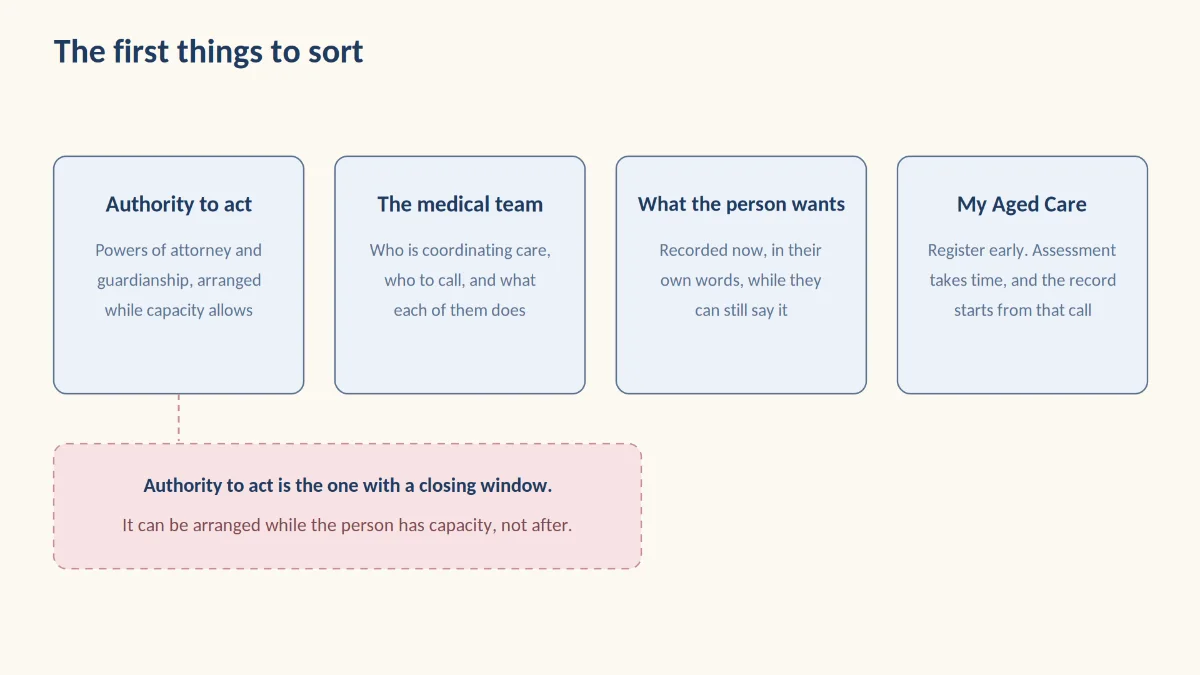
- Make sure the person has given someone authority to act, and that their wishes are understood. This has to happen while they can take part in it, and it is the single most important thing to sort early.
- Get the medical side right. A GP who knows the person, and a geriatrician or specialist. There are treatments worth discussing and medication worth reviewing properly.
- Register with My Aged Care now, even if you need nothing yet. The wait is long, and you cannot shorten it later.
- Think carefully before moving someone. A smaller place or a village sounds easier, but a person with dementia knows their own environment, and moving can make things worse.
- Use the time. Ask them the questions you will wish you had asked, while they can still enjoy telling you.
Written by Louise Greene RN and Kerry Mann, aged care specialists. Reviewed September 2026. Sources: My Aged Care, the Department of Health, Disability and Ageing and Dementia Australia.
The type of dementia · The medical team · Authority to act · What the person wants · Capturing their story · Registering early · What to put in place · Whether to move · The carer · Looking ahead
Do you know which type of dementia it is?
This sounds like a technical question and it is not.
Dementia is not one condition. It is a group of them, and they behave differently.
Alzheimer’s disease is the most common, around 60 to 70 per cent of cases. It usually starts with memory: forgetting recent events, repeating questions, misplacing things, and it tends to progress gradually.
Vascular dementia is caused by reduced blood flow to the brain, often after a stroke or from small vessel disease. It can come on suddenly or slowly, and it often affects attention, planning and problem solving more than memory.
Frontotemporal dementia typically affects people in their fifties and sixties. It changes behaviour, judgement, language and personality, and memory can stay relatively intact early on. Families often find this the hardest to make sense of, because the person seems like themselves and behaves like somebody else.
Lewy body dementia brings visual hallucinations, sleep disturbance, tremors and alertness that fluctuates through the day. One thing worth knowing and telling every doctor involved: people with Lewy body dementia are often very sensitive to antipsychotic medications.
A surprising number of families come to us knowing there is a diagnosis but not knowing which kind, or having been told once in a difficult appointment and not taken it in. That is completely normal. Go back and ask.
While you are there, ask what the diagnosis actually means for this person. Not dementia in general. This person, at this stage.
Who should be on the medical team after a dementia diagnosis?
Two people, and it is worth being deliberate about both.
A GP who knows the person well. This is the relationship that carries everything else. A good GP coordinates referrals, manages the other health conditions that sit alongside dementia, reviews medications, and provides the written summaries you will need later for an assessment, a hospital admission or an aged care home. Ask for longer appointments when there is a lot to cover, and ask about registering with MyMedicare, which formally links the person to their practice.
A geriatrician, or another specialist who knows dementia. This is the part families most often skip, and it matters. A diagnosis is the beginning of the journey, not the end of it. There are treatments worth discussing, medications worth reviewing, and new options coming. You want somebody who can properly assess what may or may not help this person, and who will keep reviewing it as things change.
Memory clinics are worth asking about too. Many hospitals and health services run them, and they offer comprehensive assessment and planning in one place. Your GP can refer you.
Get the medical advice right early. Everything else is easier when that part is settled.
Has the person given someone authority to act?
If there is one thing to do this month, it is this.
Make sure the person has formally given someone authority to act on their behalf, and that their wishes are clearly written down and understood by the family. That means an enduring power of attorney, and an advance care directive setting out what they would want.
The reason it is urgent is simple. These decisions have to be made while the person is able to make them. Leave it, and the family ends up applying for guardianship at the worst possible moment, with the person no longer able to say what they would have chosen.
Done early, it is the person deciding. Done late, it is done to them.
These are legal documents and the rules differ between states, so get proper advice. But do not let that become a reason to put it off.
What does the person actually want?
Ask them, while they can tell you.
How are they managing at the moment, honestly? What is still fine, and what has become hard? Where do they want to live, and what matters most to them about how they live?
Everything downstream depends on this. It shapes what support to put in place, when, and eventually what kind of care will suit. It is also the conversation families most regret not having earlier, because the answers get harder to reach as time goes on.
There are usually more strategies available than people realise, and small changes can make daily life simpler and safer without anything formal being involved at all.
Should you be capturing their story?
This is the part nobody tells you, and families who do it are always glad they did.
A diagnosis gives you something unexpected, which is a reason to have the conversations you would otherwise keep putting off. Ask them about their childhood. How they met. What they were like at twenty. The job they loved and the one they hated. The questions you will wish you had asked, ask them now, while they can still tell you and still enjoy telling you.
Record it. Voice notes on your phone are enough. Video if they will let you. Write things down as they come up rather than planning a project you never start. There are apps designed for exactly this, which prompt you with questions and keep the answers in one place.
There is a practical side too. A life story is one of the most useful things you can hand to a support worker, a respite service or an aged care home. It tells them who this person is rather than what they can no longer do, and it is often the difference between care that fits and care that does not. The Staying at Home program does life story work for this reason.
Mostly though, do it because it is time you will not get back, and because it is one of the few things about this that is genuinely a gift.
Should you register with My Aged Care after a dementia diagnosis?
Yes, even if you need nothing yet.
Register with My Aged Care on 1800 200 422 and get the assessment process started. The wait is long, and there is no way to shorten it retrospectively. Getting registered and into the queue is the single most useful administrative thing you can do early.
It commits you to nothing. An assessment commits you to nothing. A referral code sits unused until you decide to use it.
When the assessment does come around, prepare for it properly. It is one hour, and what gets described in that hour shapes what is approved and how long you wait. Our assessment guide walks through the whole process, and we cover it in detail in Aged Care School.
What can you put in place while you wait?
Quite a lot, and none of it requires funding.
Sort out who does what. A family roster with tasks actually allocated works better than everyone meaning well. Shopping, appointments, medications, the phone calls. Write it down.
Look at the informal supports around the person. Neighbours, friends, community groups, the things they already do and enjoy.
Connect with the support programs. Dementia Australia runs free programs including the Living with Dementia Program and Memory Lane Cafes, which the person and their carer attend together. Community groups like Umbrella Dementia Cafes in Victoria run social groups for couples living with dementia. These are genuinely valuable and they work best while the person can take part and enjoy them.
Look at Staying at Home. This is a free program run by Dementia Support Australia, a two night retreat that the carer and the person attend together. The carer spends time with dementia specialists, and the person is supported separately doing things they enjoy. It is often somebody’s first experience of respite, in a setting designed to make that experience a good one, which matters because the first experience of respite is usually a crisis.
Consider paying privately in the meantime. Some families put a small amount of paid support in place while they wait for funded support to come through. It is worth knowing that is an option.
Should you move them somewhere smaller or easier?
Think very carefully before you do.
This one comes up constantly. The house is too big, the garden is too much, and moving to a unit, a retirement village or an assisted living place feels like the sensible thing to do while everyone is still able to manage it.
But a person living with dementia knows their own environment. They know where the bathroom is at night. They know which way the kitchen is. That knowledge is doing an enormous amount of work, and it does not transfer. Moving someone to an easier house can make things noticeably worse, and it often does.
That does not mean never. It means the decision has to be made with the person’s longer term needs in mind, not just the practicalities of the house, and it is worth getting advice before anyone lists a property.
How is the dementia carer going?
Ask this properly, and ask it about yourself too.
The person we worry about most is an older partner caring at home. They will not tell you they are struggling, they will not identify as a carer, and by the time it becomes obvious, two people are in trouble instead of one.
Talk about their health. Talk about how they are getting a break, and whether they are getting one at all. Carer Gateway, 1800 422 737, is free and is for the carer in their own right.
Relationships change through this, and that is one of the hardest parts. When someone’s behaviour alters, the people closest to them often take it personally, and they should not have to work out how to respond on their own. That is a large part of why we wrote Discussing Dementia.
If behaviour is hard to make sense of, Dementia Support Australia is free and available 24 hours on 1800 699 799. They deliver the Dementia Behaviour Management Advisory Service, which gives practical strategies for things like agitation, night-time wandering or refusing care, and they will work with you at home.
What about looking ahead?
Looking early is not giving up. It is usually reassuring.
We worked recently with a man whose wife has dementia. They wanted to see the aged care homes in their area before she needed one, and to understand what it would cost. They visited a few, and what they found was that there were some lovely homes nearby. They came away feeling supported rather than frightened, which is not what they expected.
We also introduced them to some Support at Home providers, and they have arranged a little private support while they wait for funding to come through.
That is what looking early does. It replaces a vague dread with actual information, and it means that if something changes suddenly, nobody is making a decision in a hospital corridor with no idea what the options are.
Frequently asked questions
What should you do first after a dementia diagnosis?
Make sure the person has given someone formal authority to act on their behalf and that their wishes are written down, while they can take part in those decisions. Then get the medical side right with a GP and a specialist.
Do you need to arrange aged care straight after a dementia diagnosis?
No, but register with My Aged Care on 1800 200 422 and get an assessment underway. The wait is long and there is no way to shorten it later. Registering costs nothing, commits you to nothing, and a referral code sits unused until you decide to use it.
Does the type of dementia matter?
Yes, a great deal. Alzheimer’s disease, vascular dementia, frontotemporal dementia and Lewy body dementia progress differently and bring different changes with them. Knowing which one you are dealing with helps you understand what to expect, what is likely to help, and in the case of Lewy body dementia, which medications to be careful about.
Should someone with dementia move to a smaller home or a retirement village?
Often not, or at least not without advice first. A person living with dementia relies heavily on knowing their own environment, and that knowledge does not move with them. A smaller or easier house can make daily life harder rather than simpler, so weigh it against their longer term needs.
Which type of dementia does someone have?
Ask the GP or specialist directly. The main types are Alzheimer’s disease, vascular dementia, frontotemporal dementia and Lewy body dementia. They progress differently and bring different changes, and knowing which one you are dealing with helps you understand what to expect.
Where can families get free support after a diagnosis?
Dementia Australia runs free programs including Memory Lane Cafes and the Living with Dementia Program. Dementia Support Australia runs the free Staying at Home retreat and a 24 hour line on 1800 699 799. Carer Gateway supports carers on 1800 422 737.
The bottom line
A dementia diagnosis is the beginning of the journey, not the end of it.
The first things to sort are not aged care. Make sure someone has authority to act and that the person’s wishes are understood, while they can take part in that. Get a good GP and a specialist involved. Ask the person what they want, and listen properly to the answer.
Then register with My Aged Care, because the wait is long and starting costs you nothing. Put informal supports in place while you wait. Look after whoever is doing the caring. And be careful about moving anyone, however sensible it seems.
Looking ahead early is not giving up. Almost every family we work with says it made things feel less frightening, not more.
Our guide Discussing Dementia goes further into the day to day. How communication changes and what helps when reasoning and correcting stop working. What abilities remain and how to support them. And what to do when someone asks to go home while they are sitting in their own lounge room.
Get the Discussing Dementia guide
Aged Care Conversations provides independent, commission-free aged care guidance and cost modelling. It does not provide financial, taxation, legal or medical advice.
Program rules and funding arrangements are set by government and change over time. Always confirm current details for your situation with My Aged Care on 1800 200 422.
Sources: My Aged Care, the Department of Health, Disability and Ageing and Dementia Australia.
For More Information
Call us, or book a free 15-minute conversation. If we’re not the right help for you, we’ll say so – and point you somewhere that is.