
What happens at an aged care assessment?
- Louise Greene and Kerry Mann

An assessor from the Single Assessment Service (formerly ACAT) goes through a structured series of questions with you about how you manage day to day with key tasks such as showering, dressing, meals, medications, getting around the house and leaving the house. They will ask what assistance you need and what help you already have in place. It usually takes about an hour. Most assessments happen at home, but they can also be done by phone, or at the bedside if someone is in hospital. It is arranged through My Aged Care on 1800 200 422, and there is no cost at any stage.
Table of Contents
ToggleIt will feel like a conversation, and it is meant to. Underneath it, the assessor is working through a structured tool called the Integrated Assessment Tool, and your answers are entered into it and scored. That scoring is what produces your classification and your priority rating. Nobody sits afterwards and weighs up how you seem, so how you convey your situation matters enormously.
Accuracy matters more than politeness here. Play things down, as most people instinctively do, and the result is an under-assessment: less funding than the situation warrants, a lower priority rating, and a reassessment months later to put it right.
- An Aged Care Assessment is free. Arrange it through My Aged Care on 1800 200 422. Nobody should ever charge you for this.
- If you were told to book an ACAT, that is this. ACAT, ACAS and RAS were merged into the Single Assessment Service, so there is now one number to call and no working out which team you need.
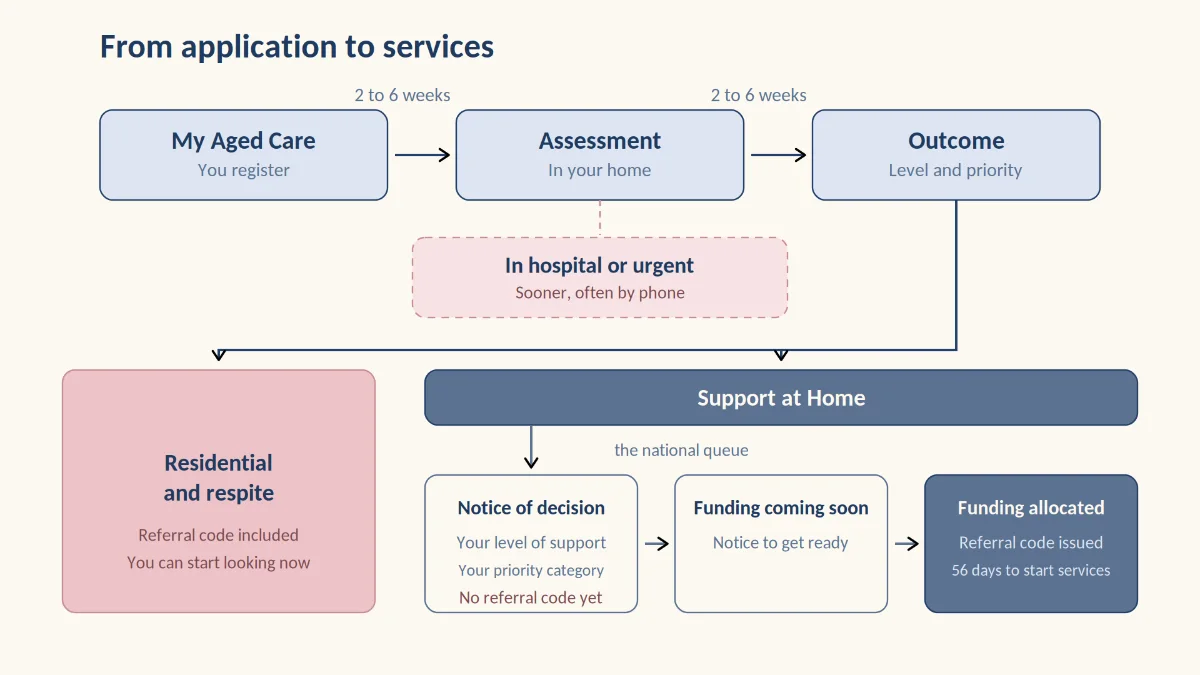
- Allow two to six weeks to be assessed, then two to six more for the written outcome. Urgent situations move faster. After approval the two paths separate: respite and residential care can start once you have your referral code, but Support at Home funding joins a national queue, and that wait can be long.
- Describe your worst days, not your average day. Understate it and you will be under-assessed, which means less funding and a reassessment months later to correct it.
- You will be given three things: a Support Plan, a referral code for each approved service, and a priority rating that sets how long you wait.
Written by Louise Greene, Registered Nurse. Reviewed by Kerry Mann, September 2026. Last updated September 2026. Sources: My Aged Care and the Department of Health, Disability and Ageing.
What the acronyms mean · Who is eligible · How to apply · How to prepare · What happens on the day · What you receive · How to start services · If things change
What do all the acronyms mean?
Aged care runs on abbreviations, and most families meet them all at once. Here is the short version.
| Term | What it means |
| My Aged Care | The Australian Government’s front door to government-funded aged care. 1800 200 422, or myagedcare.gov.au. |
| Single Assessment Service (SAS) | The single national workforce trained to assess for all aged care programs. |
| ACAT, ACAS and RAS | Aged Care Assessment Team, Aged Care Assessment Service (in Victoria) and Regional Assessment Service were previously separate assessment teams. All three are now the Single Assessment Service. |
| Integrated Assessment Tool (IAT) | The national question set assessors use. It tailors the depth of questions to your situation. |
| Support Plan | The written summary you receive after the assessment: your strengths, challenges, goals, preferences and approved services. |
| Referral code | The key that unlocks each approved service. You receive one per approved service and give it to your chosen provider. |
| National Prioritisation System | How waiting time for Support at Home funding is ordered. Ratings run Urgent, High, Medium and Low. |
| Support at Home | The in-home care program that replaced Home Care Packages on 1 November 2025. |
| CHSP | Commonwealth Home Support Programme. Entry-level help at home. Continues until at least 1 July 2027. |
| Registered Supporter | Someone you nominate to help you make and communicate your own decisions. Sometimes called a representative. |
| OPAN | How waiting time for Support at Home funding is ordered. Ratings run Urgent, High, Medium and Low. |
If you have been told to book an ACAT assessment, you have not been misinformed. It was the name for years and everyone in the sector still knows what you mean.
Who can get an aged care assessment?
You may be eligible for government-funded aged care if you are 65 or over, or 50 or over and Aboriginal or Torres Strait Islander, and one of the following applies.
- You are experiencing changes in health, mobility, memory or daily function
- You need support to keep living safely at home
- Your carer is under strain
- You have had a recent fall, hospital stay or change in living arrangements
Some people under those ages may be eligible in exceptional circumstances. Call My Aged Care to discuss it.
The quickest way to check is the eligibility checker on the My Aged Care website. It confirms your eligibility to be considered for an assessment and asks whether you have difficulty with everyday tasks: getting out of a chair, walking, showering, dressing, preparing a meal, taking medicine, housework, transport, shopping, managing money.
Answer honestly rather than optimistically. This is the first place people understate what they are struggling with, and your responses decide whether the checker takes you through to the more detailed questions and on to applying for an assessment.
How do you apply for an assessment?
Apply online at myagedcare.gov.au, or call My Aged Care on 1800 200 422. The online application takes around twenty minutes and has three parts.
Part A, your situation. Health events such as falls or emergency visits, how you are managing daily tasks, current supports, emotional wellbeing, and any changes to living arrangements, finances or safety. This section impacts your prioritisation for assessment, so it is essential to be well prepared and answer honestly to reflect your level of need.
Part B, contact details and representation. The Medicare number and contact details of the person being assessed, plus details of anyone authorised to act on their behalf.
This is where you nominate a Registered Supporter, and we recommend doing it now rather than later. A Registered Supporter can speak with My Aged Care on the person’s behalf, give consent, have a referral code generated, and request a review of the support plan. Without one, you may be told that your parent’s file cannot be discussed with you, usually at the moment you most need it discussed.
It helps to be clear with your parent about what the role is. A Registered Supporter helps an older person make and communicate their own decisions. It is not power of attorney and it does not hand anyone control. People who bristle at the idea of someone acting for them are often comfortable with someone helping them be heard.
Allow up to ten business days for that relationship to be established, which is why it belongs in the application rather than in a phone call three weeks later.
Part C, arranging the assessment. Who the assessment organisation should contact.
Once submitted, My Aged Care assigns the application to a local assessment organisation. Expect contact within two to six weeks, depending on urgency.
If the situation is urgent, say so. After a fall, a hospital discharge, or a carer becoming unavailable, call 1800 200 422, explain what has changed, and ask for the assessment to be prioritised.
How should you prepare for the assessment?
Preparation is the part older people and families skip and later regret.
Have your documents ready. Medicare card plus one other form of identification. Referrals from a doctor or specialist. Contact details for the GP and other health professionals. Discharge documents from a recent hospital stay. A list of the support already in place, formal and informal.
Think about your worst days, not your best ones. Write down the tasks you struggle with, even the ones you still manage sometimes. People instinctively describe the good day, and the good day is not what needs funding.
Ask for a time of day that suits. If concentration or energy is better in the morning, ask for a morning appointment.
Check where it will happen. Most assessments are at home, but they can be done by phone or at the bedside in hospital. A hospital assessment can be arranged urgently before discharge, and the hospital social worker or discharge planner can help request one.
Bring a support person. Your Registered Supporter, a family member, a friend or a carer can be a prompt and can help with the conversation, providing information and recording what is said.
Ask for communication support if you need it. Interpreters and Auslan support can be arranged – tell My Aged Care when the assessment is being organised rather than on the day.
Everything above is a printable checklist in our assessment guide, along with the assessor’s full question list so you can work through your answers and be prepared before the day rather than on it.
What happens during the assessment?
The assessment is designed as a conversation rather than a test, even though the questions behind it are standard. The assessor already has the information from your application. They will confirm your consent, ask whether they may speak with the people who support you, and then work through the Integrated Assessment Tool (IAT) with you.
The setting varies. A home visit is the most common, and it lets the assessor see the environment , the bathroom and the kitchen for themselves. A phone assessment may be offered where needs are lower or distance is a factor. In hospital, the assessment happens at the bedside, usually before discharge is planned.
The IAT covers communication, the reason for the assessment, current services and supports, daily living and function, health, frailty, social connections, cognition, behaviour, psychological wellbeing, home and safety, financial and legal matters, and special considerations such as risk of harm or cultural needs.
Some of it feels informal. Questions about your children’s names, or what you did before you retired, are part of the cognitive screen. If dementia is already in the picture, the assessment works differently and is easier to get wrong.
Ask for everything you might want. If you are being assessed for help at home and residential respite might be useful later in the year, ask for it now. Getting it added afterwards means another assessment, and another wait.
And ask about interim support. If there will be a wait for Support at Home funding, ask the assessor whether interim funding or interim services such as meals or transport can be arranged in the meantime.
What do you get at the end?
Three things.
Your Support Plan. A written summary of your strengths and challenges, your goals, the outcomes you hope for, and your preferences for how and when support is delivered. You may receive it at the end of the visit, or by email or post afterwards, and you can view it in your My Aged Care online account. Allow two to six weeks.
Referral codes. One for each service you have been approved for. A referral code is the key that unlocks that service. You give it to the provider you choose, and it lets them see your assessment, accept the referral and arrange a start date. If you decide not to proceed, the code is not lost. You can activate it later through your online account or by calling 1800 200 422, and if a provider cannot start when you need them, you can offer the code to a different one.
Your prioritisation. For Support at Home there is a National Prioritisation System, based on safety and carer capacity. Ratings run Urgent, where someone is unsafe alone at night or a carer is in crisis, then High, Medium and Low. The higher the rating, the shorter the wait. Funding for the Restorative Care and End-of-Life pathways is allocated immediately on approval.
How do you start services?
This is where the paths separate, and it is the part families most often misunderstand. Being approved is not the same as being funded.
Residential aged care, for respite or permanent care, means contacting the home you have chosen and giving them your details and referral code. There is no national queue for this, so the limit is whether the home has a place. If the situation is urgent, this is usually the faster route. Fees are separate from the assessment, and there are four of them rather than one.
Commonwealth Home Support Programme means contacting local providers directly and asking about availability. Your assessor may be able to make a referral for you or provide a list of potential services.
Support at Home is different. Approval puts you in a national queue rather than into services, and you should plan for a wait. You will receive three letters. Letter one confirms approval and your place in the queue. Letter two tells you funding is expected soon and it is time to choose a provider. Letter three confirms the funding is available, alongside your referral code.
Because that wait can run for months, ask the assessor about interim support at the time of the assessment rather than later, and call to be re-prioritised the moment anything changes.
Care only begins once you agree to proceed, so there is time to compare providers, ask about fees and continuity, and check earliest start dates before committing.
What if the outcome is wrong, or things change?
You can ask for a review. Call My Aged Care on 1800 200 422 and explain what is missing or what has changed, with concrete examples: dates of falls, emergency visits, medication errors, a carer becoming unwell. You will not lose your place in the queue while a review or reassessment is under way.
Do not wait quietly in the queue. You can request a reassessment at any time while you are waiting, and you should do it the moment anything changes: a deterioration in health, a fall, a hospital stay, a carer who can no longer continue, or the person no longer feeling safe at home.
A reassessment can upgrade the priority rating, release the budget earlier, and unlock interim services in the meantime. Waiting changes nothing on its own. The people who move up the list are the ones who ring.
Keep a running log while you wait. A few lines each time is enough, as long as it records:
- Incidents, with the date and what happened afterwards
- Carer strain: disrupted sleep, lifting, time taken off work
- Weight loss, poor appetite, or meals being missed
- Medication doses missed, doubled, or taken at the wrong time
- New hazards around the house, and any equipment that would help
On the phone, reading from a log is far more persuasive than recalling from memory. It is also much harder to wave away.
Frequently asked questions
Is it still called an ACAT assessment?
Not officially. Aged Care Assessment Teams, ACAS in Victoria, and the Regional Assessment Service were brought together into the Single Assessment Service. Everyone in the sector still understands the term ACAT, so you will not be misunderstood if you use it.
How much does an aged care assessment cost?
Nothing at all. Assessment through My Aged Care is free, regardless of income or assets, and that applies whether it happens at home, by phone or in hospital. Nobody should ever charge you for arranging or attending a government aged care assessment.
How long does it take to get an assessment?
Usually two to six weeks from application to assessment, depending on urgency and local demand. If circumstances change while you are waiting, call 1800 200 422 and ask to be re-prioritised rather than waiting quietly.
Can someone be with me during the assessment?
Yes, and it is a good idea. A Registered Supporter, family member, friend or carer can attend. One person keeps the conversation going while the other notes what is being recorded.
What is a Registered Supporter?
Someone you nominate to help you make and communicate your own decisions about aged care. They can speak with My Aged Care for you, give consent, have referral codes generated and request a support plan review. It is not power of attorney and it does not take away your right to decide.
Do I have to use my referral codes straight away?
No. Codes remain available if you decide to wait. You can activate them later through your My Aged Care online account or by calling 1800 200 422, and you can offer them to a different provider if your first choice cannot start.
What if I disagree with the outcome?
Call My Aged Care and ask for a review, with specific examples and any supporting notes from a GP or hospital. Your place in the queue is not affected while a review or reassessment is under way, so raising it costs you nothing.
The bottom line
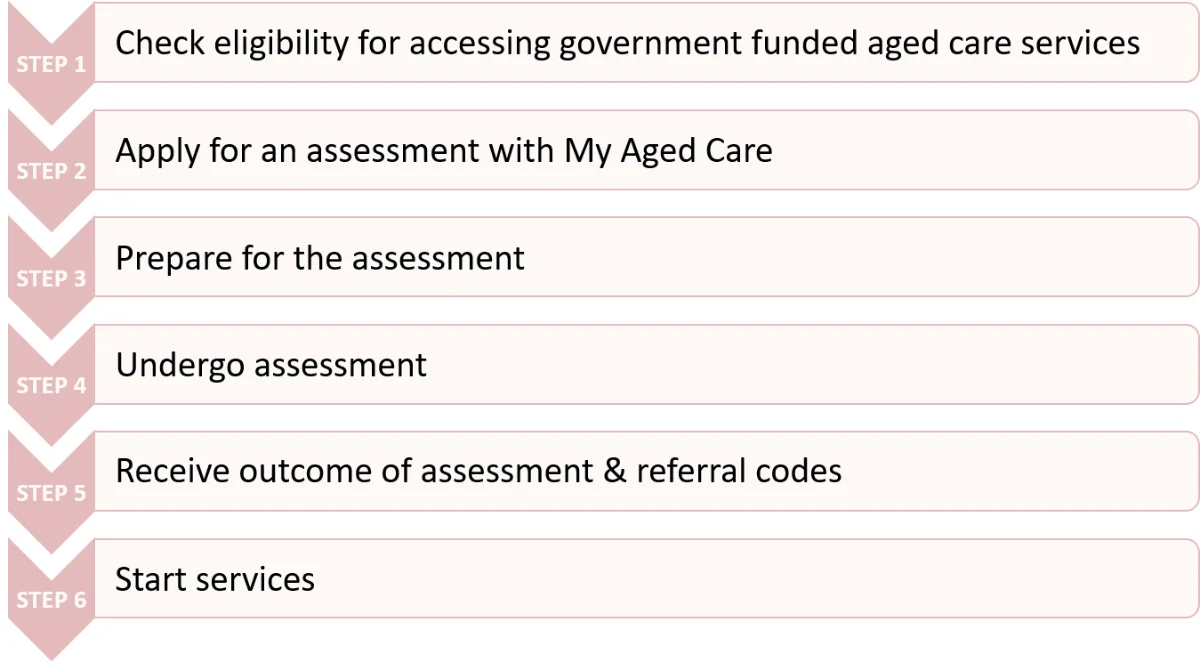
An aged care assessment is a free, roughly hour-long conversation with an assessor from the Single Assessment Service, arranged through My Aged Care on 1800 200 422. It follows six steps: check eligibility, apply, prepare, undergo the assessment, receive your outcome, and start services.
The two things that make the most difference are both within your control. Describe your worst days rather than your average day, because prioritisation follows what you describe. And ask for every service you might need, because adding one afterwards means going through the process again.
The outcome is a Support Plan, a referral code for each approved service, and a priority rating. Some of it may be handed over on the day, but more often it follows by email or post, and it can take two to six weeks to arrive. None of it commits you to anything until you choose a provider and agree to start.
This article is what to expect. The guide is what to say.
Inside it: the eligibility checklist and the application questions written out, so you can prepare your answers instead of improvising them. The assessor’s full question list, domain by domain, so nothing catches you cold on the day. Word-for-word phone scripts and an email template for requesting priority, re-prioritisation or a reassessment. An incident log for recording falls and near-falls as they happen, because that log is the evidence that changes a priority rating. And three worked examples, from a hospital discharge to a mother whose memory was slipping, showing exactly what was approved and why.
One hour decides what your family is funded for and how long you wait for it. Most people get that hour once.
Get the assessment guide
General information only. This article explains how the aged care assessment process works and is not financial, legal or medical advice. Program rules and funding arrangements are set by government and change over time. Always confirm current details for your situation with My Aged Care on 1800 200 422 or at myagedcare.gov.au.
Sources: My Aged Care and the Department of Health, Disability and Ageing.
For More Information
Call us, or book a free 15-minute conversation. If we’re not the right help for you, we’ll say so – and point you somewhere that is.