
Aged Care Means Testing Explained
- Louise Greene and Kerry Mann

Aged Care Means Testing Explained: How the Income and Assets Test Works Under the New Aged Care Act
The aged care means test is an assessment of the older person’s income and assets by Services Australia. It decides how much they contribute towards their care, both at home under Support at Home and in an aged care home.
Table of Contents
ToggleThe same assessment works quite differently in the two settings. The biggest difference is the family home, which is not counted for Support at Home but can be counted, up to a cap, for residential care.
This article explains what counts, how the family home is treated, what the result means at home and in an aged care home, and what the fee estimators can and cannot tell you. It covers the rules that apply from 1 November 2025, under the new Aged Care Act.
- The means test is run by Services Australia (or DVA for some veterans). Pensioners usually do not need to fill in a new form, because Services Australia already has their details.
- For Support at Home, the means test sets a contribution percentage for each type of service. The family home is not counted.
- For an aged care home, the means test works out a daily means tested amount. That decides whether the person pays for their room and how much they contribute to everyday living and non-clinical care. The home can be counted, up to a cap, unless a partner or another protected person still lives there.
- Nobody has to complete a means assessment. Without one, the person pays the maximum.
- The fee estimators on My Aged Care give a guide only. The real figure comes from Services Australia.
Written by Louise Greene RN and Kerry Mann, aged care specialists. Reviewed October 2026. Sources: My Aged Care, Services Australia, and the Department of Health, Disability and Ageing.
What the means test is · What counts · The family home · Support at Home · Aged care homes · The home in practice · Fee estimators · Choosing not to disclose · If the result looks wrong · Who can help
What is the aged care means test?
It is the income and assets assessment Services Australia uses to work out what an older person pays towards government funded aged care. It is similar to the Age Pension means test, and it draws on much of the same information.
Clinical care is never means tested. Nursing and allied health are fully funded, at home and in an aged care home. The means test applies to the other parts of the cost: help around the house and with daily living at home, and accommodation, everyday living and non-clinical care in an aged care home.
The new Aged Care Act, which started on 1 November 2025, changed the fees and contributions the means test is used to determine. At home, contributions now depend on the type of service. In aged care homes, the means tested care fee was replaced by the hotelling contribution and the non-clinical care contribution. It did not change which types of income and assets count, or the basic treatment of the family home.
What counts as income and assets?
Broadly, the same things that count for the Age Pension.
Income includes pensions, superannuation income streams, wages, rent and business income. Financial investments such as bank accounts, shares and managed funds are not assessed on what they actually earn. They are deemed to earn a set rate, and the deemed amount counts as income.
Assets include savings, shares, superannuation, investment properties, cars, caravans, boats and household contents. Some things are exempt, including certain payments such as National Redress Scheme payments.
For couples, income and assets are combined and each person is treated as owning half, even if only one of them needs care.
How is the family home treated?
This is where most of the confusion sits, because the home is treated differently for Support at Home, for residential care and for the Age Pension.
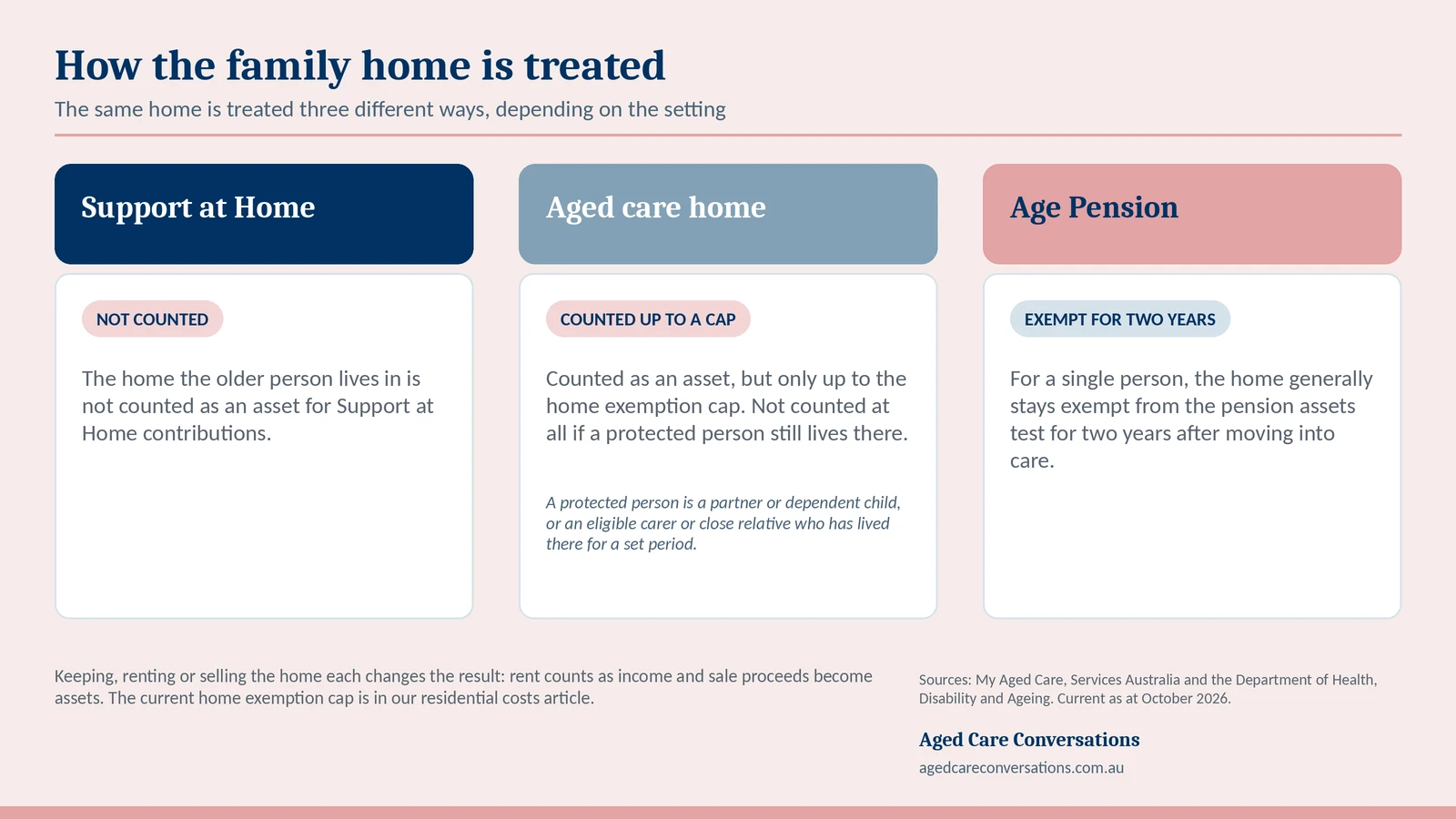
Support at Home. The home the person lives in is not counted as an asset at all.
Residential aged care. The home is counted, but only up to the home exemption cap. It is not counted at all if a protected person still lives there. A protected person is a partner or dependent child, or a carer or close relative who has lived there for a set period and is eligible for an income support payment. The current cap is in the figures table further down this article.
The Age Pension. For a single person, the home generally stays exempt from the pension assets test for two years after they move into care. This is a separate rule from the aged care means test, and the two often cause confusion.
When someone moves into an aged care home, what happens to the family home becomes one of the biggest decisions. Keeping, renting or selling it will each change the means test result, because rent counts as income and sale proceeds become assets. Most moves into residential aged care follow a crisis, such as a fall or a hospital stay, rather than being planned, so families often face this decision at the hardest possible time. It rarely needs to be made straight away. There are 28 days after entry to decide how to pay for the room, and for a single person the home stays exempt from the Age Pension assets test for two years. That leaves time to understand the options before committing to one.
How does means testing work for Support at Home?
For Support at Home, the means test sets a contribution percentage for each of the three service categories. Clinical supports, which since 1 October 2026 include personal care, have no contribution. Independence and everyday living services do.
Full pensioners pay the lowest rates, and Services Australia uses the information it already holds.
Part pensioners and Commonwealth Seniors Health Card holders pay a rate within a range, set from their income and assets.
Self-funded retirees without a card pay the highest rates.
People who do not receive a pension, or whose details Services Australia does not already hold, complete the Support at Home calculation of your cost of care form (SA456) once they are approved. The rates are backdated to the day they started Support at Home.
Anyone who had or was approved for a Home Care Package on or before 12 September 2024 is protected by the no worse off principle. If they were not paying an income tested care fee under their package, they do not pay contributions under Support at Home.
Our Support at Home guide sets out the rates by category, with a worked example.
How does means testing work in an aged care home?
In an aged care home, Services Australia uses the income test and the assets test to work out a daily figure called the means tested amount.
The income tested amount is 50 per cent of assessable income above the income free area. The asset tested amount is worked out from assessable assets above the asset free area, at different percentages across a series of indexed thresholds. The two added together make the means tested amount.
Key figure | Amount from 20 September 2026 |
Income free area, single | $36,455 per year |
Asset free area | $66,500 |
Home exemption cap | $219,858.40 |
Maximum accommodation supplement | $73.73 per day |
These figures are indexed on 20 March and 20 September each year. The full set of current fees and caps is in how much residential aged care costs.
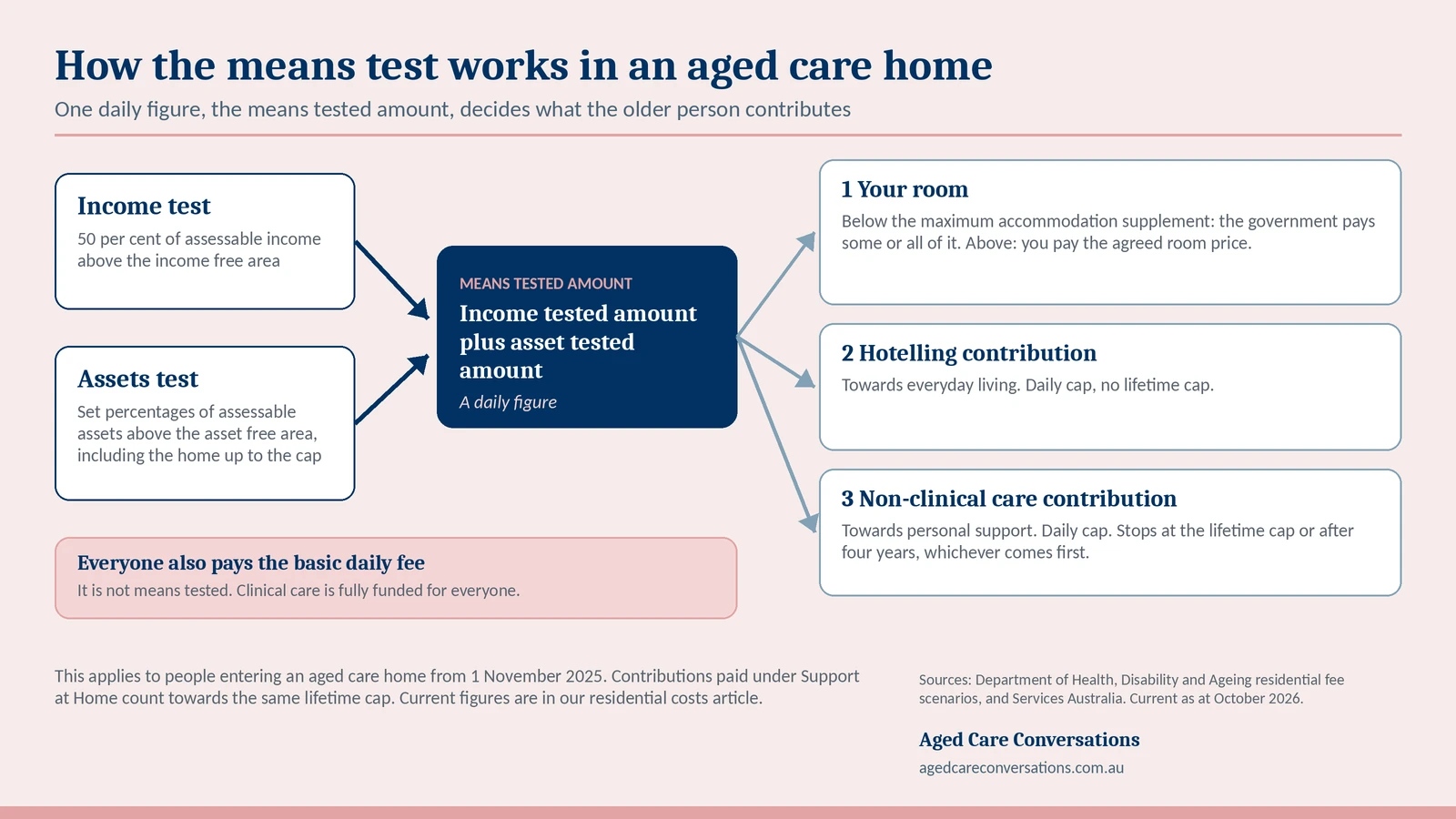
That one figure then decides three things.
Whether the person pays for their room. If the means tested amount is below the maximum accommodation supplement, the government pays some or all of the accommodation cost and the person is a supported or partially supported resident. If it is above, they pay the agreed room price, as a refundable accommodation deposit, a daily payment or a mix of both.
The hotelling contribution. A contribution towards everyday living services, with a daily cap and no lifetime cap.
The non-clinical care contribution. A contribution towards personal support such as help with bathing and mobility, with a daily cap and a lifetime cap. It stops when the lifetime cap is reached or after four years, whichever comes first. Contributions paid under Support at Home count towards the same lifetime cap.
Everyone also pays the basic daily fee, which is not means tested.
The Department of Health, Disability and Ageing publishes worked fee scenarios that take real examples through each step of the calculation.
What is the means tested care fee?
It is the fee that applied under the old rules. People who entered an aged care home before 1 November 2025 still pay it, with its own annual and lifetime caps. People entering from 1 November 2025 do not. The hotelling contribution and the non-clinical care contribution replace it.
RAD or DAP?
The means test decides whether the person pays a room price at all. If they do, the choice between a refundable accommodation deposit (RAD), a daily accommodation payment (DAP) or a combination is theirs, and they have 28 days after entry to decide. We explain the options, and the retention on deposits, in how much residential aged care costs.
Which form?
For residential care, it is the Residential aged care calculation of your cost of care form (SA457). If the person already receives a means tested income support payment and owns their home, it is the SA485 instead. A fee advice letter issued before entry is generally valid for 120 days.
How does the family home change the result?
Joan is a single part pensioner. She owns her home, worth $850,000, and has $120,000 in savings and shares.
While Joan lives at home with Support at Home, her house is not counted. Her contribution percentages are set from her pension and her $120,000 in savings and shares.
If Joan moves into an aged care home and nobody else lives in her house, the house is counted, but only up to the home exemption cap of $219,858.40. Her assessable assets become $339,858.40 rather than $120,000, almost three times as much, even though nothing about her finances has changed.
At that level, her means tested amount is likely to be above the maximum accommodation supplement of $73.73 a day. She would then pay the agreed price for her room, and may also contribute to hotelling and non-clinical care. Services Australia would confirm the exact figures.
If Joan had a partner still living in the house, it would not be counted at all, and the result could be very different.
Most of the families we speak with are surprised by how much the home changes things between the two settings. It is also why a fee estimate done for home care is no guide to what an aged care home will cost.
Do the fee calculators give you the real figure?
They give you a guide. My Aged Care has two estimators: a Support at Home fee estimator and an aged care home fee estimator. Private fee calculators work in a similar way.
They are useful for getting a sense of the range before you start. They are only as good as the figures you put in, and they cannot allow for every rule, such as a protected person living in the home.
The real figure comes from Services Australia, after a completed income and assets assessment. That is the number to plan around.
What if you do not want to disclose your finances?
Completing a means assessment is not compulsory. Some people choose not to, often because they know they will pay the maximum anyway, or because they want to keep their finances private.
Without an assessment, the person is treated as means not disclosed and pays the maximum contribution rates for Support at Home, or the maximum amounts in an aged care home. It is worth comparing the two before deciding, because the gap can be large.
What if the result looks wrong, or you cannot afford it?
Ask for a review. If the income and assets assessment looks wrong, you can ask Services Australia, or DVA where relevant, to review the decision.
Keep the details up to date. Changes to income or assets, such as selling the home or a change in a partner’s situation, need to be reported. They can change the contribution in either direction.
Ask about financial hardship assistance. If the contributions are genuinely unaffordable, Services Australia can assess an application for financial hardship assistance, which may reduce what the person pays.
Who can help?
Aged Care Specialist Officers at Services Australia can explain the assessment and help with the forms, in person or by phone, at no cost.
Your own accountant or financial planner. Many financial planners work with aged care, and it is worth asking yours what they do. They already know the family’s finances, and decisions about the home, deposits and investments are closely linked.
Services Australia’s Aged Care line on 1800 227 475 can answer questions about the assessment and your fee advice letter.
Frequently asked questions
What is the aged care means test?
It is an assessment of an older person’s income and assets by Services Australia, similar to the Age Pension means test. It decides how much they contribute towards Support at Home services and towards the costs of living in an aged care home. Clinical care, including nursing and allied health, is never means tested.
Is the family home included in the aged care means test?
For Support at Home, no. The home the person lives in is not counted. For an aged care home, it is counted up to the home exemption cap, unless a partner, dependent child or another protected person still lives there, in which case it is not counted at all.
How accurate is the My Aged Care fee estimator?
It gives a useful guide, based on the figures you enter, and it is a good way to get a sense of the range before you start. It cannot allow for every rule. The actual amount is set by Services Australia after a completed income and assets assessment.
Do pensioners need to fill in a form?
Usually not for Support at Home, because Services Australia already has their income and asset details from the pension. For residential care, pensioners who own their home generally complete the SA485 so the home can be assessed. Self-funded retirees complete the SA456 or SA457.
Does everyone entering an aged care home pay a means tested care fee?
No. People entering an aged care home from 1 November 2025 do not pay the means tested care fee. Depending on their means, they may pay a hotelling contribution and a non-clinical care contribution instead. People who entered before that date continue under the old rules.
What happens if you do not complete a means assessment?
Completing one is not compulsory. Without it, the person is treated as means not disclosed and pays the maximum contribution rates for Support at Home, or the maximum amounts in an aged care home. It is worth comparing the two before deciding, because the difference can be large.
The bottom line
The means test is one assessment with two quite different results. At home, it sets a contribution percentage and ignores the family home. In an aged care home, it produces a daily figure that decides whether you pay for your room and what else you contribute, and the home can count.
The fee estimators are a reasonable starting point. The figure to plan around is the one Services Australia gives you, and the decisions that shape it, particularly about the home, do not have to be rushed, even when the move itself is.
We work through the numbers with older people and families, including what happens to the home, so the costs of each option are clear before anyone signs anything.
Aged Care Conversations provides independent, commission-free aged care guidance and cost modelling. It does not provide financial, taxation, legal or medical advice.
Fees, thresholds and program rules are set by government and change over time. Information in this article is current as at the date shown above. Always confirm current details with Services Australia on 1800 227 475 or My Aged Care on 1800 200 422.
For More Information
Call us, or book a free 15-minute conversation. If we’re not the right help for you, we’ll say so – and point you somewhere that is.