
Respite Care Explained
- Louise Greene and Kerry Mann

Respite Care Explained: Aged Care Respite Types, Costs and How to Arrange a Break From Caring
Respite care is short term care for an older person that gives the person who usually cares for them a break. It can happen at home, at a day centre, overnight in a cottage, or in an aged care home for a few days or several weeks.
Table of Contents
ToggleResidential respite is available for up to 63 days a financial year, and it costs the basic daily fee, with no accommodation charge. Respite at home is funded through Support at Home or the Commonwealth Home Support Programme (CHSP). Most respite needs an aged care assessment first, but emergency respite can be arranged quickly through Carer Gateway on 1800 422 737.
- There are five main types: in-home, day, overnight, residential and emergency respite.
- Residential respite is available for up to 63 days each financial year, and can be extended by up to another 21 days with an assessor’s approval.
- Residential respite costs the basic daily fee. There is no accommodation charge and no means tested contribution.
- Carers receiving Carer Payment or Carer Allowance can take up to 63 days of respite each calendar year without their payment stopping, as long as they tell Services Australia.
Written by Louise Greene RN and Kerry Mann, aged care specialists. Reviewed October 2026. Sources: My Aged Care, Services Australia, Carer Gateway, and the Department of Health, Disability and Ageing.
What respite is · Types of respite · Arranging it · How long it lasts · What it costs · Carer payments · Making it work
What is respite care?
Respite means a short break. In aged care respite, someone else provides the care for a while, so the person who usually does it can rest, work, travel, attend to their own health, or simply stop for a few days.
Respite is often thought of as a break for the carer. For the older person, it is care in its own right, and the best respite works for both of them. A good day program can be the highlight of someone’s week. A short stay in an aged care home after a hospital admission can be a safe place to recover.
The older person should know about respite, be part of choosing it, and, where they are able, agree to it. Respite arranged around them rather than with them is much harder to settle into.
Carers often leave it too long. Respite works best when it is planned in before exhaustion sets in, not arranged in a crisis once it has.
What types of respite care are there?
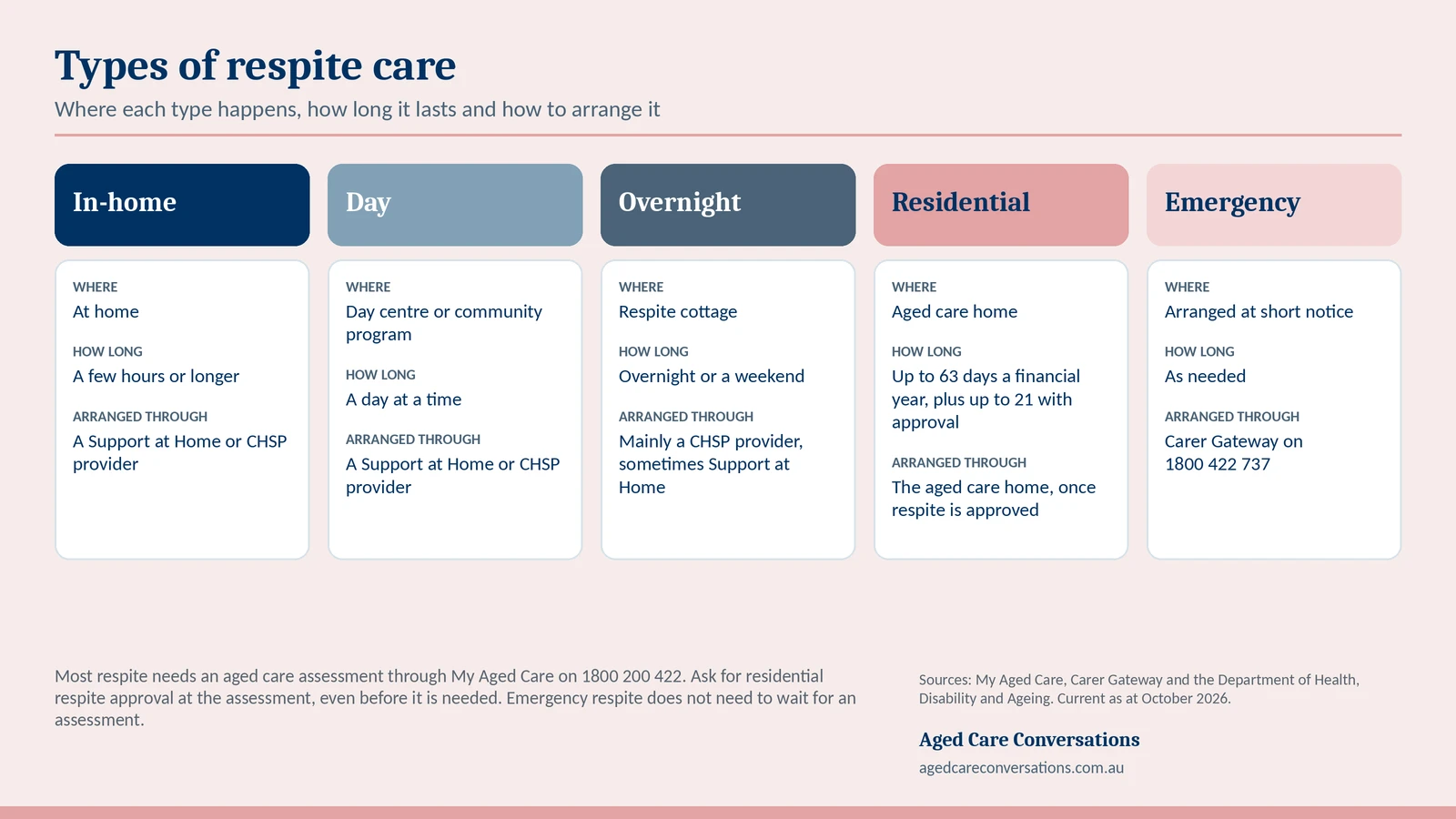
In-home respite. In home respite care means a care worker comes to the home and stays with the older person, for a few hours or longer, while the carer goes out or rests. The older person stays in familiar surroundings, which often suits people living with dementia.
Day respite. The older person spends the day at a day centre or community program, with activities, a meal and company. Transport is often included.
Overnight or cottage respite. A short overnight or weekend stay in a home-like cottage run by a respite provider. Cottage respite is mainly offered through CHSP, and some providers accept Support at Home funding for it.
Residential respite. A stay in an aged care home, from a few days to several weeks. It suits longer breaks, recovery after a hospital stay, or times when the care needed at home is more than one person can manage.
Emergency respite. Short notice care when the carer suddenly cannot continue, for example because they are unwell or have a family emergency.
How do you arrange respite care?
Start with an aged care assessment. Most government funded respite needs an aged care assessment through My Aged Care on 1800 200 422. The assessment approves the types of respite the older person can receive. Residential respite needs its own approval, so it is worth asking for it at the assessment even if it is not needed yet.
For in-home, day or overnight respite, the service is arranged through the older person’s Support at Home provider or a CHSP provider.
For residential respite, contact aged care homes directly to ask about availability. Many homes keep a small number of respite beds, and popular times, such as school holidays and the weeks around Christmas, book out early.
For emergency respite, call Carer Gateway on 1800 422 737. They can arrange short notice respite without waiting for an assessment.
Someone on the waiting list for Support at Home funding, or for a permanent place in an aged care home, can still use respite in the meantime.
How long can someone stay in respite care?
Residential respite is available for up to 63 days each financial year, from 1 July to 30 June. The days can be taken all at once or spread across several stays. If more is needed, an aged care assessor can approve up to another 21 days.
In-home, day and overnight respite have no fixed number of days. How much is available depends on the older person’s Support at Home budget or the CHSP services on offer.
There is a second 63 day rule that is easy to confuse with this one. Carers receiving Carer Payment or Carer Allowance can take up to 63 days of respite each calendar year, from 1 January to 31 December, without their payment stopping. The two limits count different things, run over different years, and are managed by different agencies.
How much does respite care cost?
Residential respite. The older person pays the basic daily fee, which is $68.93 a day from 20 September 2026. There is no accommodation charge and no means tested contribution. The home may ask for a booking fee to hold the place, but it has to be deducted from the fees once the stay begins. Some homes offer optional extras through a Higher Everyday Living Fee, which must be agreed in writing and is never a condition of the stay.
Respite through Support at Home. Respite is in the independence category, so the older person pays a contribution towards it: 5 per cent of the price for a full pensioner, and more for people with higher means. The rest comes from their quarterly budget. Our Support at Home guide explains the contribution rates.
Respite through CHSP. CHSP providers set their own contributions, which are usually modest. Ask the provider what they charge before the service starts.
What happens to Carer Payment and Carer Allowance during respite?
Carers can take up to 63 days of respite each calendar year and keep receiving Carer Payment or Carer Allowance. During those days, the older person can be in formal respite, at home with someone else, or cared for by family or friends.
Services Australia needs to be told within 14 days. If the person being cared for goes into hospital, there are separate hospital days that do not use up the respite days.
Carer Payment is an income support payment for people who provide constant care. It is paid at the same rate as the Age Pension, up to $1,237.70 every two weeks for a single person from 20 September 2026, and it is income and assets tested. Carers can work, study or volunteer for up to 100 hours over four weeks and keep it.
Carer Allowance is a smaller supplementary payment for people who provide daily care. It is not assets tested, and it can be paid on top of Carer Payment, the Age Pension or wages, provided the combined adjusted taxable income of the carer and their partner is under $250,000 a year. Many carers who are working do not realise they may be eligible.
How do you make respite work well?
Start small. A day program or a short in-home visit before a longer stay helps everyone get used to the idea.
Visit first. Before residential respite, visit the home together if possible, meet some of the staff and see the room.
Take the person’s life with them. A medication list, a note of routines and preferences, and a short life story tell staff who the person is, not only what they need help with. Familiar things from home help too.
Use it as a trial. For many families, residential respite is the first real experience of an aged care home. It is a chance to see how the older person settles, and how the home works, before any decision about moving permanently.
Plan the return. Know when the stay ends and what support will be in place at home afterwards.
Frequently asked questions
What is respite care?
Respite care is short term care for an older person that gives their usual carer a break. It can be provided at home, at a day centre, in an overnight cottage, or in an aged care home. It is funded through Support at Home, the Commonwealth Home Support Programme or residential respite.
How long can someone stay in respite care?
Residential respite is available for up to 63 days each financial year, taken all at once or across several stays. An aged care assessor can approve up to another 21 days if needed. In-home and day respite have no fixed number of days and depend on available funding.
How much does residential respite cost?
The older person pays the basic daily fee, $68.93 a day from 20 September 2026. There is no accommodation charge and no means tested contribution. A booking fee may be asked for to hold the place, but it is deducted from the fees once the stay begins.
Do you need an assessment for respite care?
For most government funded respite, yes. An aged care assessment through My Aged Care approves the types of respite, and residential respite needs its own approval. In an emergency, Carer Gateway on 1800 422 737 can arrange short notice respite without waiting for an assessment.
Can you keep Carer Payment while using respite?
Yes. Carers can take up to 63 days of respite each calendar year and keep receiving Carer Payment or Carer Allowance. Services Australia must be told within 14 days, and hospital stays for the person being cared for have separate days of their own.
Can respite lead to a permanent place in an aged care home?
It can. Residential respite is often a family’s first experience of an aged care home, and some people decide to stay on permanently. That needs its own approval, a separate agreement, and the full fees and means assessment for permanent care.
The bottom line
Respite is one of the most useful parts of the aged care system and one of the least used. It gives carers a real break, and it gives the older person care, company and sometimes a safe place to recover.
Residential respite is available for up to 63 days a year for the basic daily fee, and respite at home is funded through Support at Home or CHSP. Get approval at the aged care assessment, even before it is needed, and plan breaks before exhaustion rather than after it.
Carers who receive Carer Payment or Carer Allowance can take up to 63 days of respite a calendar year and keep their payment, as long as Services Australia is told.
If you are caring for someone and not sure where to start, we can help you work out what respite is available and how to arrange it.
Aged Care Conversations provides independent, commission-free aged care guidance. It does not provide financial, taxation, legal or medical advice.
Fees, payment rates and program rules are set by government and change over time. Information in this article is current as at the date shown above. Always confirm current details with My Aged Care on 1800 200 422, Services Australia or Carer Gateway on 1800 422 737.
For More Information
Call us, or book a free 15-minute conversation. If we’re not the right help for you, we’ll say so – and point you somewhere that is.