
What Is Support at Home?
- Louise Greene and Kerry Mann
What Is Support at Home? The Aged Care Program That Replaced Home Care Packages
Support at Home is the Australian Government program that funds aged care at home. It replaced the Home Care Packages Program and Short-Term Restorative Care on 1 November 2025.
Table of Contents
ToggleIt funds help with nursing, personal care, allied health, cleaning, meals, transport and home modifications, through a quarterly budget set by an aged care assessment. What the older person pays depends on the type of service and their income and assets.
- Support at Home replaced Home Care Packages on 1 November 2025. There are now eight funding classifications instead of four package levels.
- The classification is set by the aged care assessment, and the budget is released quarterly.
- Services sit in three categories. Clinical supports, such as nursing and allied health, cost you nothing. Independence and everyday living services attract a contribution based on your income and assets.
- From 1 October 2026, personal care, such as showering and dressing, moved into clinical supports. There is no longer a contribution for it.
- Anyone who had or was approved for a Home Care Package on or before 12 September 2024 will pay the same or less than they did under the old program.
Written by Louise Greene RN and Kerry Mann, aged care specialists. Reviewed October 2026. Sources: My Aged Care, the Department of Health, Disability and Ageing, and the Support at Home program manual.
What changed · The eight classifications · If you had a Home Care Package · What it pays for · Fees · The 1 October change · Short term support · How to get it · Choosing a provider
What changed when Home Care Packages ended?
The Home Care Packages Program had four levels. Support at Home has eight ongoing classifications, which gives more steps between low and high needs.
Three other things changed with it.
The budget is quarterly. Funding is released every three months, in July, October, January and April, rather than accruing month by month.
Contributions depend on the service. Under Home Care Packages, most people paid a flat basic daily fee regardless of what they used. Under Support at Home, you contribute a percentage of the price of each service, and the percentage depends on the type of service and your income and assets.
The assessment sets the funding. The classification comes from the aged care assessment, and since 1 November 2025 the assessor cannot change what the assessment tool produces. We explain how that works in the aged care assessment explained.
The question we hear most often is how many hours of care a package buys. It never bought a set number of hours, and neither does Support at Home. It is a budget. How far it goes depends on which services are used and what the provider charges for them.
What are the eight Support at Home classifications?
Classification 1 is for the lowest level of ongoing need and Classification 8 for the highest. The classification sets the budget, and the budget includes 10 per cent that goes to the provider for care management.
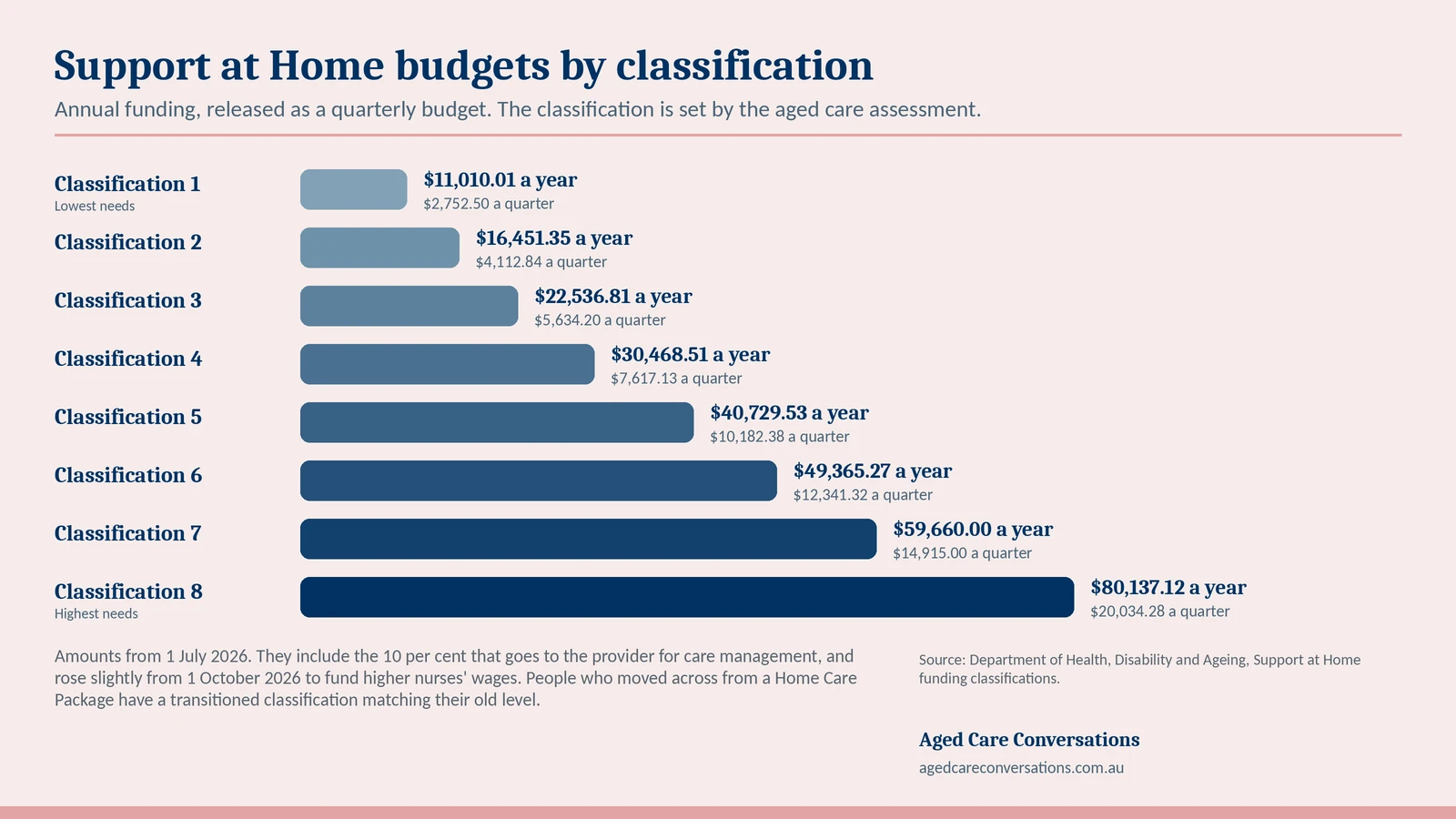
Classification | Quarterly budget | Annual amount |
Classification 1 | $2,752.50 | $11,010.01 |
Classification 2 | $4,112.84 | $16,451.35 |
Classification 3 | $5,634.20 | $22,536.81 |
Classification 4 | $7,617.13 | $30,468.51 |
Classification 5 | $10,182.38 | $40,729.53 |
Classification 6 | $12,341.32 | $49,365.27 |
Classification 7 | $14,915.00 | $59,660.00 |
Classification 8 | $20,034.28 | $80,137.12 |
These are the published amounts from 1 July 2026. Budgets increased slightly from 1 October 2026 to fund higher award wages for aged care nurses. The classification itself does not change.
If some of the quarterly budget is not used, up to $1,000 or 10 per cent of the quarterly budget, whichever is more, carries over to the next quarter.
What happened to people who had a Home Care Package?
They moved across to Support at Home on 1 November 2025 with a transitioned classification that matches their old package level.
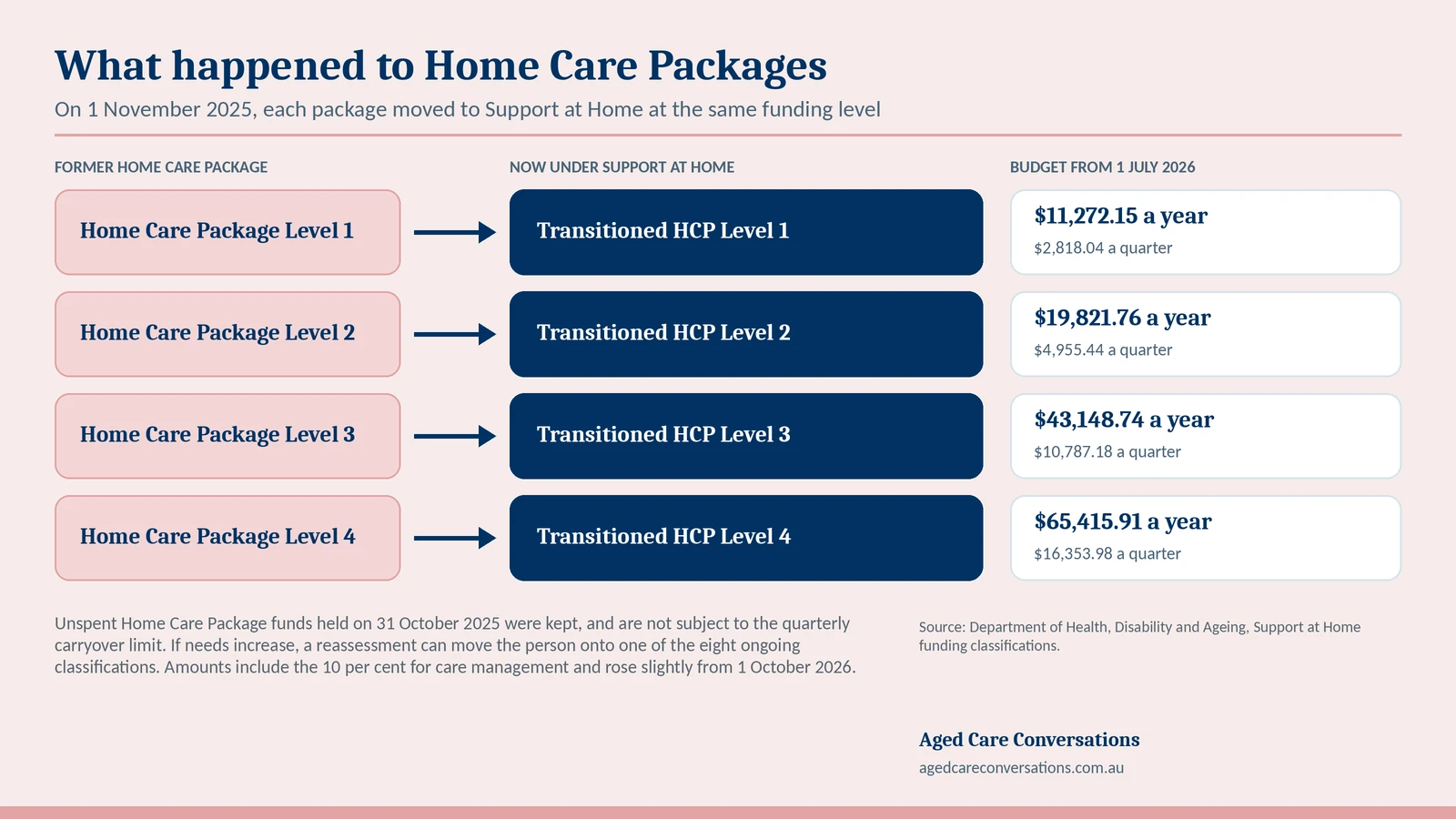
Former package | Transitioned classification | Quarterly budget | Annual amount |
Level 1 | Transitioned HCP Level 1 | $2,818.04 | $11,272.15 |
Level 2 | Transitioned HCP Level 2 | $4,955.44 | $19,821.76 |
Level 3 | Transitioned HCP Level 3 | $10,787.18 | $43,148.74 |
Level 4 | Transitioned HCP Level 4 | $16,353.98 | $65,415.91 |
Any unspent Home Care Package funds held at 31 October 2025 were kept, and they are not subject to the quarterly carryover limit.
If needs have increased, the older person can ask for a support plan review. A reassessment may move them onto one of the eight ongoing classifications.
What does Support at Home pay for?
The Support at Home service list groups services into three categories.
Clinical supports. Nursing, allied health such as physiotherapy, occupational therapy, podiatry and speech pathology, and from 1 October 2026, personal care.
Independence. Help to stay independent and connected, such as respite, transport, social support and help with the home and daily routine.
Everyday living. Help around the house, such as cleaning, laundry, meals, gardening and home maintenance.
The budget pays for approved services only, and the services have to be in the older person’s support plan. It does not cover rent, household bills or everyday groceries.
Equipment and home modifications are funded separately, through the Assistive Technology and Home Modifications scheme, so they do not come out of the quarterly budget.
What are the Support at Home fees?
What you pay depends on three things: the category of service, the older person’s income and assets, and the price the provider charges.
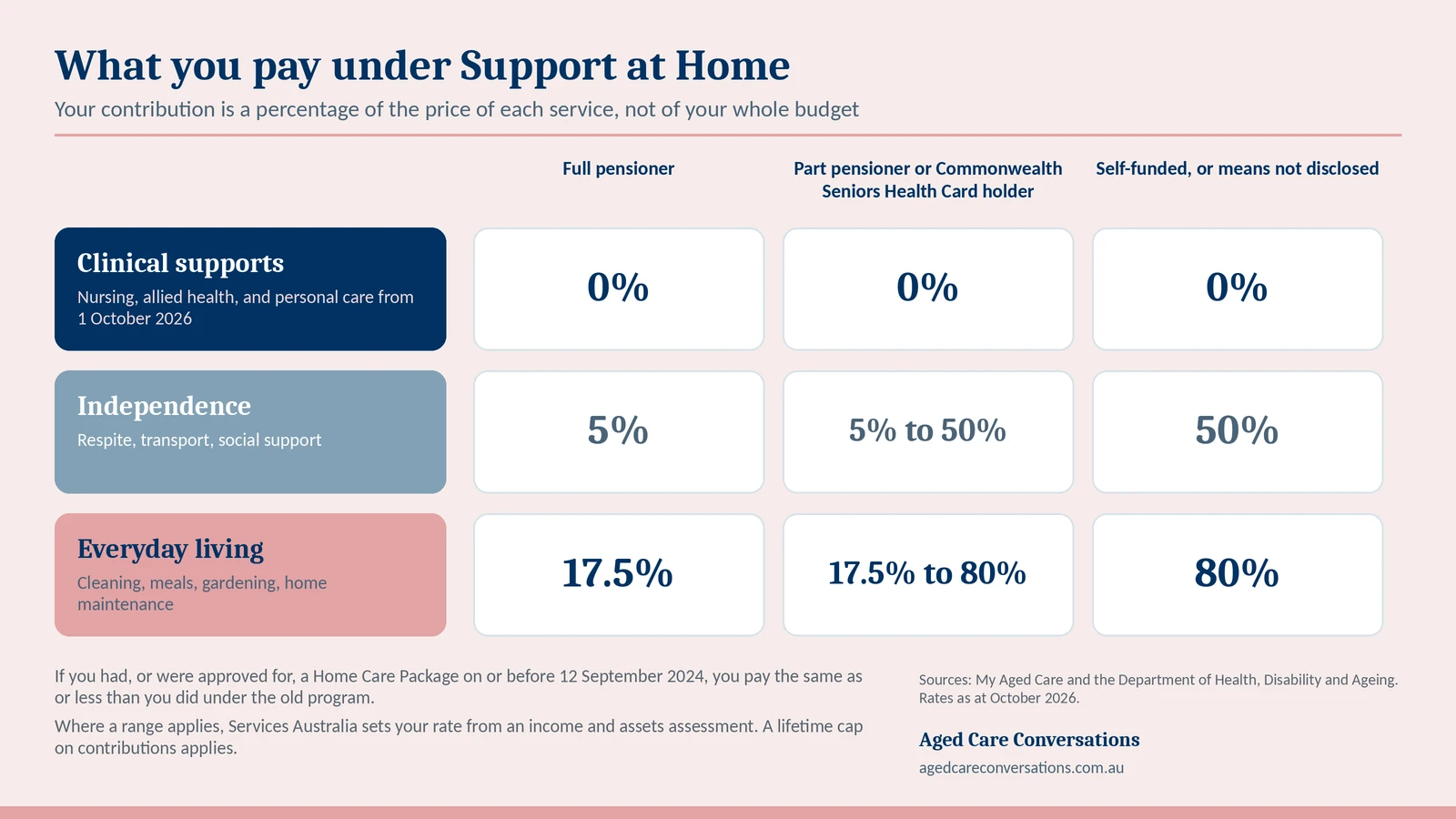
Category | Full pensioner | Part pensioner or Commonwealth Seniors Health Card holder | Self-funded, or means not disclosed |
Clinical supports | 0% | 0% | 0% |
Independence | 5% | 5% to 50% | 50% |
Everyday living | 17.5% | 17.5% to 80% | 80% |
The percentage applies to the price of each service, not to the whole budget. Services Australia works out the rate from an income and assets assessment. We explain how that assessment works in our guide to aged care means testing.
An example: what Margaret pays
Margaret is a full pensioner on Classification 3. Her quarterly budget is $5,634.20, and 10 per cent of it goes to her provider for care management. Each week she has an hour of cleaning and an hour of help with each of two showers.
For this example, her provider charges $80 an hour for both. Prices vary between providers, so this is an illustration, not a typical rate.
Over a quarter, that is 13 hours of cleaning and 26 hours of personal care.
Cleaning is everyday living. Margaret pays 17.5 per cent, which is $14 an hour, or $182 for the quarter.
Personal care is a clinical support from 1 October 2026. She pays nothing. Before 1 October she paid 5 per cent, or $104 a quarter.
Her services come to $3,120 a quarter at these prices, well within her budget, so there is room to add other help such as transport or physiotherapy. A provider charging $95 an hour instead would change every one of those numbers, which is why the price matters as much as the percentage.
Anyone who had or was approved for a Home Care Package on or before 12 September 2024 is covered by the no worse off principle. They pay the same as, or less than, they would have under the old program.
There is a lifetime cap on contributions for independence and everyday living services. Contributions paid under Support at Home count towards the same lifetime cap as residential aged care, which is explained in how much residential aged care costs.
What does home nursing cost?
Nursing sits in clinical supports, so there is no contribution. It is paid from the Support at Home budget, which means it uses up funds that could otherwise go to other services.
What changed on 1 October 2026?
From 1 October 2026, personal care moved from the independence category into clinical supports. Showering, dressing, eating, personal hygiene and non-clinical continence care no longer attract a contribution.
Three things stay the same. Personal care still has to be approved in the support plan. It is still paid from the quarterly budget. And the budget does not get bigger because of the change.
For many people this is a real saving. Personal care is often the service used most, and some families have been cutting back on showers to keep the cost down. That no longer needs to happen.
Contributions still apply to services in the other two categories, such as cleaning, gardening and transport. Personal care delivered before 1 October 2026 still attracts the old contribution, even if the provider claims for it later.
What short term support is available?
Alongside the eight ongoing classifications, Support at Home has three short term options.
The Restorative Care Pathway. A short burst of allied health and nursing to help someone regain strength and independence. It is worth asking about after a hospital stay or a fall, when the goal is to get back to how things were rather than to add ongoing care.
The End-of-Life Pathway. Extra support at home for people in the last three months of life who want to stay at home.
The Assistive Technology and Home Modifications scheme. Equipment such as walking frames and shower chairs, and changes to the home such as grab rails and ramps.
Each one is approved through the aged care assessment.
How do you get Support at Home?
Through an aged care assessment, arranged through My Aged Care on 1800 200 422 or online. The assessment sets the classification and approves the services.
Being approved does not mean the funding starts straight away. After the assessment there is usually a wait on the Support at Home Priority System before the budget is allocated. How long depends on the priority given in the assessment.
Preparation makes a real difference to the classification. Our guide to the aged care assessment explained covers how the tool decides and how the older person and the family can prepare.
The Commonwealth Home Support Programme (CHSP) continues for now, for people who need a small amount of help. It is planned to move into Support at Home no earlier than 1 July 2027.
How do you choose a provider?
Once funding is allocated, the older person chooses a registered Support at Home provider and signs a service agreement.
Providers set their own prices, and prices vary. Providers must publish their prices and agree them with the older person before charging. You can compare published prices using the Find a provider tool on My Aged Care. The Government has deferred price caps while the market settles.
Look at the actual price of each service, not only the contribution percentage. A lower price stretches the budget further, and it also lowers the contribution.
It is worth asking any provider:
- what they charge for each service the person needs
- how they use the 10 per cent care management allocation
- how quickly services can start
- who the older person will see, and how often it will be the same worker
- what happens if needs change mid-quarter.
Frequently asked questions
Is Support at Home the same as a Home Care Package?
No. Support at Home replaced the Home Care Packages Program on 1 November 2025. It has eight classifications instead of four levels, quarterly budgets, and contributions that depend on the type of service.
What are the Support at Home classification levels?
There are eight ongoing classifications, from Classification 1 for the lowest needs to Classification 8 for the highest. People who moved across from a Home Care Package have a transitioned classification matching their old level.
Is personal care free under Support at Home?
From 1 October 2026, there is no contribution for approved personal care. It is still paid from the Support at Home budget, and it has to be in the support plan.
Do you pay for nursing under Support at Home?
No. Nursing and allied health are clinical supports, so there is no contribution. They are paid from the Support at Home budget.
How many hours of care does Support at Home provide?
There is no set number of hours. The classification sets a budget, and how many hours it buys depends on which services are used and what the provider charges.
What happens to unspent funds?
Up to $1,000 or 10 per cent of the quarterly budget, whichever is more, carries over to the next quarter. Unspent Home Care Package funds from before 1 November 2025 are kept separately and are not subject to that limit.
The bottom line
The assessment sets the classification, the classification sets the budget, and what the older person pays depends on the services they use, their income and assets, and the provider’s prices.
Clinical care and, since 1 October 2026, personal care cost nothing out of pocket. Help around the house is where most contributions fall.
The biggest difference between one person’s Support at Home and another’s is often not the classification. It is the provider, their prices, and how well the budget is planned around what the older person actually wants.
We help older people and families compare providers side by side, with the prices and the trade-offs set out clearly, so the budget goes as far as it can.
Aged Care Conversations provides independent, commission-free aged care guidance. It does not provide financial, taxation, legal or medical advice.
Funding amounts, contribution rates and program rules are set by government and change over time. Information in this article is current as at the date shown above. Always confirm current details with My Aged Care on 1800 200 422.
For More Information
Call us, or book a free 15-minute conversation. If we’re not the right help for you, we’ll say so – and point you somewhere that is.